



Meet
Get started with professional SEO services by requesting a strategy proposal today from the top-rated SEO company.

Be where your customers are and your competitors aren’t- AI search results.
Get SEO ProposalSearch engine optimization is influenced by multiple ranking factors, but link equity continues to have the greatest impact on authority and webpage rankings. Link equity refers to the authority and value a link passes from one webpage to another to share trust signals. However, it is not only about getting more quality backlinks.
Understanding link equity is important to build a stronger SEO strategy for a business. It helps determine how a business optimizes its websites, connects different pages, and manages internal linking to keep its domain strong.
Follow along with this guide to learn about link equity and how it impacts a website's SEO performance.
Link equity, also known as link juice, is the value or authority that is shared from one webpage to another through a hyperlink. When a popular or user-trusted website links to your website or webpages, it shares some authority, which improves your business credibility. Link equity is not limited to backlinks only. Strong internal linking also helps important pages receive more traffic and ranking signals that improve crawlability.
For example, if your homepage has earned high-quality SEO backlinks, linking from the homepage to your service pages allows some of that authority to flow naturally. This improves the visibility of those pages in search results.
Search engines prefer websites that are relevant, useful, and trustworthy. Link equity helps a website improve all these ranking factors, helping with better search engine visibility. However, not every link carries the same authority. Pages that are linked from reputable websites are viewed as more credible by search engine bots.
Without link equity, even high-quality content may face visibility issues. Link equity also strengthens your website by helping important pages receive additional ranking signals without requiring new backlinks.
Link equity helps with SEO improvements such as:
Focusing on link equity supports long-term SEO growth for a business. As your website acquires more high quality seo backlinks, the authority distributed across internal pages continues to strengthen your domain.
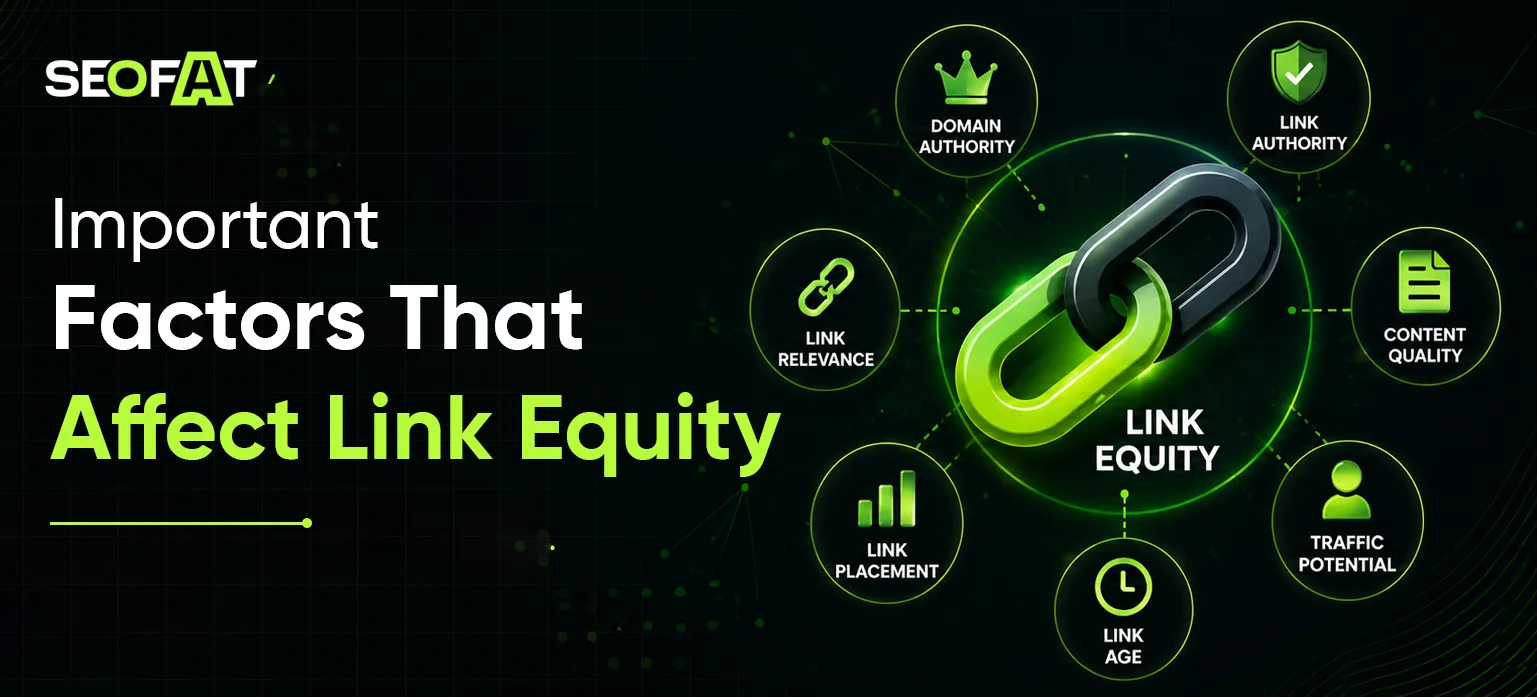
There are several factors that affect a website's link equity. These factors are evaluated by search engines for both the quality of the link and the context in which it appears. Understanding them can help you build a stronger SEO backlinks strategy for your business and improve how authority flows across your website.
The website's authority is the main driver of your link equity strength. Search engines prefer websites that share high-quality content regularly and earn organic backlinks from the industry.
Search engines consider two levels of authority:
The overall trust and credibility of the domain.
The strength and authority of the individual pages.
It is important to choose reputable sources, as they pass more value to your website than a new business.
Content relevance is important to ensure your website shares authority with another website offering related content. Search engines trust websites that share authority with relevant businesses serving the same niche and market.
Relevant links help:
Receiving backlinks from an unrelated website is less valuable for a brand's SEO growth.
Every webpage has limited authority to share. This available link equity is shared amongst all the links that connect with the website. This does not mean pages should avoid linking to popular resources. Instead, links should be used more responsibly to ensure their content marketing services provide actual value to the readers. A page with fewer, high-quality outgoing links is often stronger in authority than a page with multiple weak links.
The position of a link within a webpage influences how much value it can pass. Search engines give greater importance to links that appear naturally within the main content.
Common link placements include:
Editorial links placed naturally within the main article. These links are high in authority and credibility.
Links placed in these sections often receive less authority and relevance.
Anchor text is the clickable text users see in a hyperlink. It helps search engines focus on the content and find the link source. Clear and descriptive anchor text improves SEO by providing information about the webpage.
Good anchor text should:
Search engines use link attributes to decide if the link can be accepted for equity.
The two most common link types are:
Standard hyperlinks that allow authority flow from one page to another. It helps to strengthen SEO.
Links with the rel="nofollow" attribute. These do not let search engines pass link equity. They have no SEO importance.
Link equity comes from both external and internal links. Both link types serve different purposes and are essential for SEO growth.
These are the backlinks from other websites. They offer new authority and trust to your website, supporting it with the strongest ranking signals.
These are the links that connect pages within your own website. They distribute existing link equity and improve crawlability to improve your site structure.
A balanced SEO strategy focuses on earning both high-quality external backlinks and using internal links.
Every webpage has a source of authority, which improves its trust signals and SEO performance. If your homepage has shared authority with a top industry website, it has earned significant authority. This authority is then shared amongst your web pages supported by internal linking using keywords.
The flow of link equity usually follows a structure like this.
| Page | Source of Authority |
|---|---|
| Homepage | External backlinks |
| Service Pages | Homepage |
| Blog Category | Homepage |
| Individual Blogs | Category Pages |
| Related Articles | Internal Blog Links |
A logical site structure allows authority to flow naturally starting from the homepage. For this reason, SEO professionals regularly audit internal links to ensure important pages receive sufficient authority.
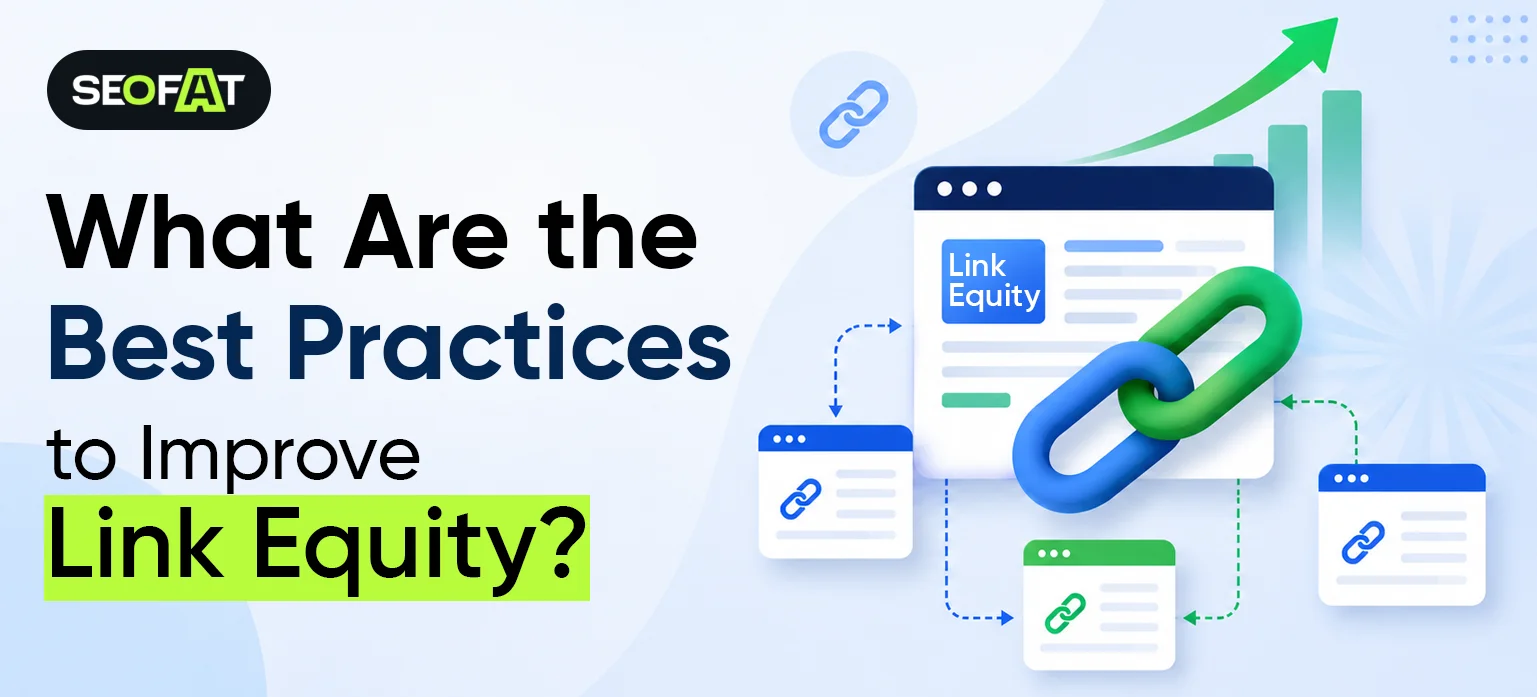
Building link equity is not only dependent on earning high-quality backlinks. Businesses also need to manage website authority through a proper internal linking strategy, a clear site structure, and regular link audits.
The following best practices will help you maximize link equity to improve your SEO performance.
Internal links are important to share authority across your website. Follow these internal linking best practices:
A strategic internal linking structure helps search engines understand all webpages. It helps with page navigation and authority.
Content clusters help to share topical authority of the business. It improves the natural flow of content and ensures your business creates pillar pages to support overall content expertise.
An effective content cluster includes:
This structure improves your expertise and authority signals on search engines.
Broken links interrupt the flow of link equity. This creates a poor user experience. Fixing broken links helps with better crawlability and higher SERP performance.
Protect your link equity by:
Maintaining a healthy link structure is important to improve SEO performance.
External backlinks add new authority to your website. High-quality backlinks pass stronger link equity and trust signals.
Effective ways to earn quality backlinks include:
Creating accurate industry content helps in earning natural backlinks organically.
Link equity needs consistent improvement to create a strong authority for your website. As you update your content and webpages, backlinks are gained or lost. Regularly reviewing your backlink profile and internal linking is important to ensure your website is supported well after every optimization.
Looking to Build a Stronger Website Authority?
SEOFAT helps businesses optimize internal linking, build high-quality backlinks, and implement targeted SEO plans to maximize online link equity and business authority. Start improving your website's authority today with top SEO services from SEOFAT.

SEO forecasting predicts future organic traffic, rankings, and revenue by analyzing historical data, search volumes,...
Read More
Pinterest is more than a social media platform. It functions primarily as a visual search...
Read More
To improve website performance in both traditional and AI search engines, brands often implement Open...
Read More
Keyword cannibalization becomes a core risk for brands that publish a high number of content...
Read More