



Meet
Get started with professional SEO services by requesting a strategy proposal today from the top-rated SEO company.

Be where your customers are and your competitors aren’t- AI search results.
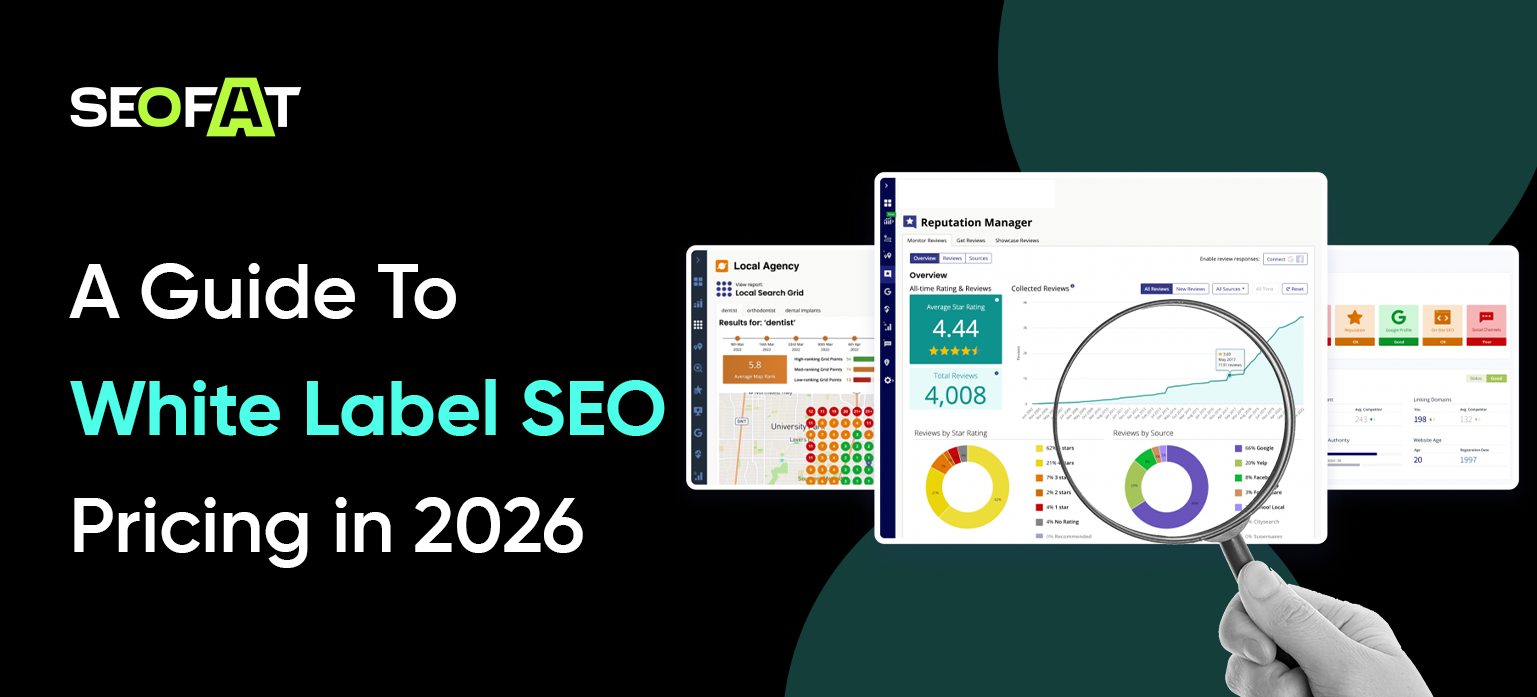
Get SEO ProposalA Guide To White Label SEO Pricing in 2026 - White-label SEO has silently become the foundation of many rapidly expanding digital agencies. Although the results are seamless and the clients only see one brand, behind the scenes, specialized SEO partners are doing the heavy-lifting. However, as brands move into 2026, white-label SEO pricing is not as straightforward as opting for flat monthly packages or per-keyword fees.
Search engines are now smarter. Customers are more knowledgeable. Results are more difficult to falsify. And agencies can no longer afford vague pricing models that don’t align with real performance.
This guide explains what white label SEO is, why pricing is changing in 2026, the most common pricing models, what really drives cost, and lastly, how SEOFAT takes a different approach to white label SEO pricing that brings transparency, scalability, and long-term growth solutions to your business.
White-label SEO is a partnership model in which one company provides SEO services that another company resells under its own brand.
In simple terms:
Clients never see the third party. Reports, dashboards, emails, and results carry your agency’s name, not the provider’s.
For agencies, this model removes the need to:
White label SEO allows agencies to concentrate on sales, relationships, and strategy while seasoned SEO providers take care of technical SEO, content optimization, link building, audits, and reporting.
In 2026, white-label SEO isn’t just about outsourcing; it’s about selecting a strategic growth partner.

SEO pricing is evolving rapidly, and 2026 marks a turning point. Here’s why white-label SEO pricing is changing so dramatically:
Search engines now prioritize search intent, topical authority, and user experience over simple keyword placement. Ranking requires deeper research, better content, and smarter technical execution, raising the cost of quality SEO.
AI tools have automated basic SEO tasks, but that hasn’t made SEO cheaper; it has made low-quality SEO obvious. Agencies now need human-led strategies layered with AI efficiency, which impacts pricing.
Monthly ranking reports are no longer enough. Clients want:
White-label SEO pricing now reflects business outcomes, not just completed tasks.
Adult SEO, casino SEO, SaaS SEO, local seo and enterprise seo all have their own challenges. Price should be based on the complexity of the niche and not on prescriptive packages.
Understanding pricing models helps agencies choose the right fit for their business goals. Here are the most common white-label SEO service pricing structures for 2026.
This is the most widely used model.
Agencies pay a fixed monthly fee for ongoing SEO services, such as:
Best for: Long-term clients and predictable workloads.
Challenge: Requires clear deliverables to avoid scope creep.
SEO services are priced individually for specific tasks like:
Best for: One-time or short-term SEO needs.
Challenge: Not ideal for sustained growth campaigns.
Pricing is based on:
Best for: Small local campaigns.
Challenge: Less effective in intent-based SEO environments.
Payment is tied to:
Best for: Confident providers with proven systems.
Challenge: Requires strong tracking and mutual trust.
A mix of fixed retainers plus performance incentives.
This is becoming increasingly popular in 2026 because it balances stability and accountability.
Not all SEO campaigns cost the same, and for good reason. Here are the real factors that influence white-label SEO pricing today.
Ranking for a local plumber is very different from ranking an adult site or a casino platform. Highly competitive niches demand:
Higher competition means higher pricing.
A 10-page website costs far less to optimize than a 10,000-page platform. Large websites require:
Local SEO is cheaper than national SEO. National SEO is cheaper than global or multi-language SEO. More locations mean more strategy, which means higher costs.
Original, expert-written, conversion-focused content significantly impacts pricing. Thin or AI-only content no longer works in 2026.
It is more difficult to get high-quality backlinks from big players in your niche, and those are the ones that really count. White-label SEO pricing is also affected by ethical link building.
Advanced dashboards, branded reports, real-time tracking, and client-friendly insights all add value and cost.
At SEOFAT, white-label SEO pricing is not built around shortcuts; it’s built around sustainable growth.
Unlike rigid packages, SEOFAT follows a customized, performance-aligned pricing approach designed for agencies that want long-term success.
Every agency and client is different. SEOFAT builds pricing around:
No one-size-fits-all SEO.
Agencies always know:
This transparency helps agencies retain clients longer.
SEOFAT specializes in competitive and sensitive niches like:
Pricing reflects real effort—not inflated promises.
Whether you manage 5 clients or 500, SEOFAT’s pricing scales without sacrificing quality or turnaround time.
All reports, dashboards, and communication are fully white-labeled, strengthening your agency’s credibility.
White label SEO pricing in 2026 is no longer about bargain deals or vague deliverables. It’s about expertise, accountability, and results.
Agencies that invest in the right white-label SEO partner gain:
If you’re serious about growing your agency without burning out your team or risking client relationships, partnering with a results-driven provider like SEOFAT isn’t only cost-effective, it’s a competitive advantage.



SEO forecasting predicts future organic traffic, rankings, and revenue by analyzing historical data, search volumes,...
Read More
Pinterest is more than a social media platform. It functions primarily as a visual search...
Read More
To improve website performance in both traditional and AI search engines, brands often implement Open...
Read More
Keyword cannibalization becomes a core risk for brands that publish a high number of content...
Read More