



Meet
Get started with professional SEO services by requesting a strategy proposal today from the top-rated SEO company.

Be where your customers are and your competitors aren’t- AI search results.
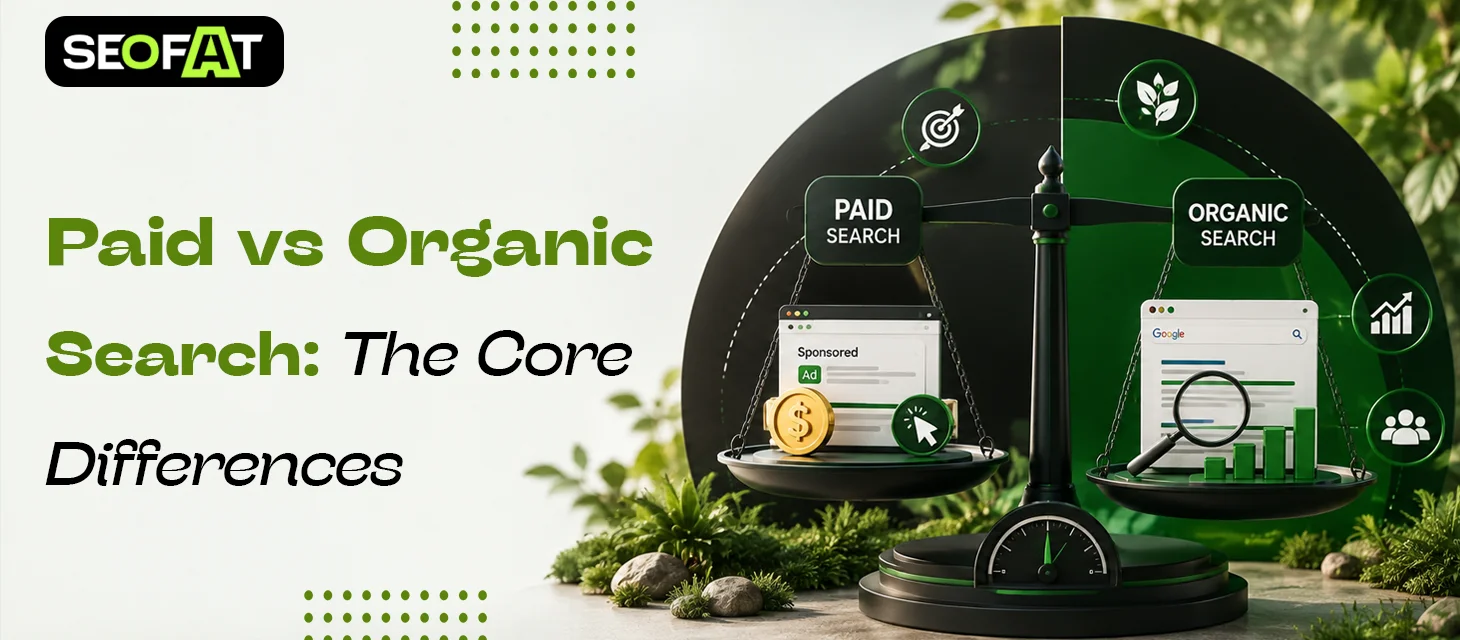
Get SEO ProposalPaid search and organic search are two of the most effective growth strategies used by every business. Paid search optimization involves paying for immediate brand placement in search results, while organic search optimization focuses on building brand trust and visibility by targeting user intent to earn true rankings based on relevance and content quality.
Both channels aim to drive targeted traffic, but they operate on fundamentally different scopes, timelines, and cost structures. In this informative guide from SEOFAT, let’s explore the core differences and benefits of paid and organic search strategies.
Organic search refers to the unpaid listings that are naturally ranked on a search engine results page (SERP). These pages are authentic, relevant, and useful for users with targeted queries that are user-focused. Search engine optimization (SEO) is the process of improving a website so its pages can earn stronger organic visibility.
SEO can involve several areas, including:
Unlike paid advertising, businesses do not pay a search engine every time someone clicks an organic result. However, organic visibility requires investment in tools and technology while keeping the optimization consistent. The biggest advantage of such optimization is ongoing SEO results that bring qualified traffic for the business in the long run.
Here is how an organic search engine optimization strategy works:
A user types keywords or targeted queries into a search engine.
The search engine scans the internet to find the most helpful and accurate keyword match for the business. It considers page authenticity and content quality to prioritize a business and rank it higher naturally.
Pages appear based on usefulness for the users. An optimized page must be targeted with user intent and focused on helping the user in simple and effective words. Website technicality and crawling ease also play a key role in ranking it higher for targeted results.
Visitors click these natural links to land on a website. As these results are not tempered or boosted, users trust these businesses more than paid advertisements.
Paid search is a digital marketing strategy. For optimization, businesses pay search engines like Google or Bing to display ads higher in search engine results pages. These paid ads use a pay-per-click (PPC) model. It means that the advertiser only pays a fee when a user actually clicks the ad, improving business engagement. Paid search provides instant results and earns quick traffic for the business.
Here is how paid search optimization strategies work:
Advertisers place their bids on specific words or search phrases. These words are targeted and focused on user queries that users commonly type into search engines.
Paid Ads appear at the top or bottom of search results. These are labeled as "Sponsored" or "Ad" to inform users that these results are not organic. Businesses can choose their ad placement to attain the best traffic for their websites.
Placement depends on your bid amount and your ad's quality score. Agencies analyze your business relevance and landing page quality to set the paid ad amounts for your website results.
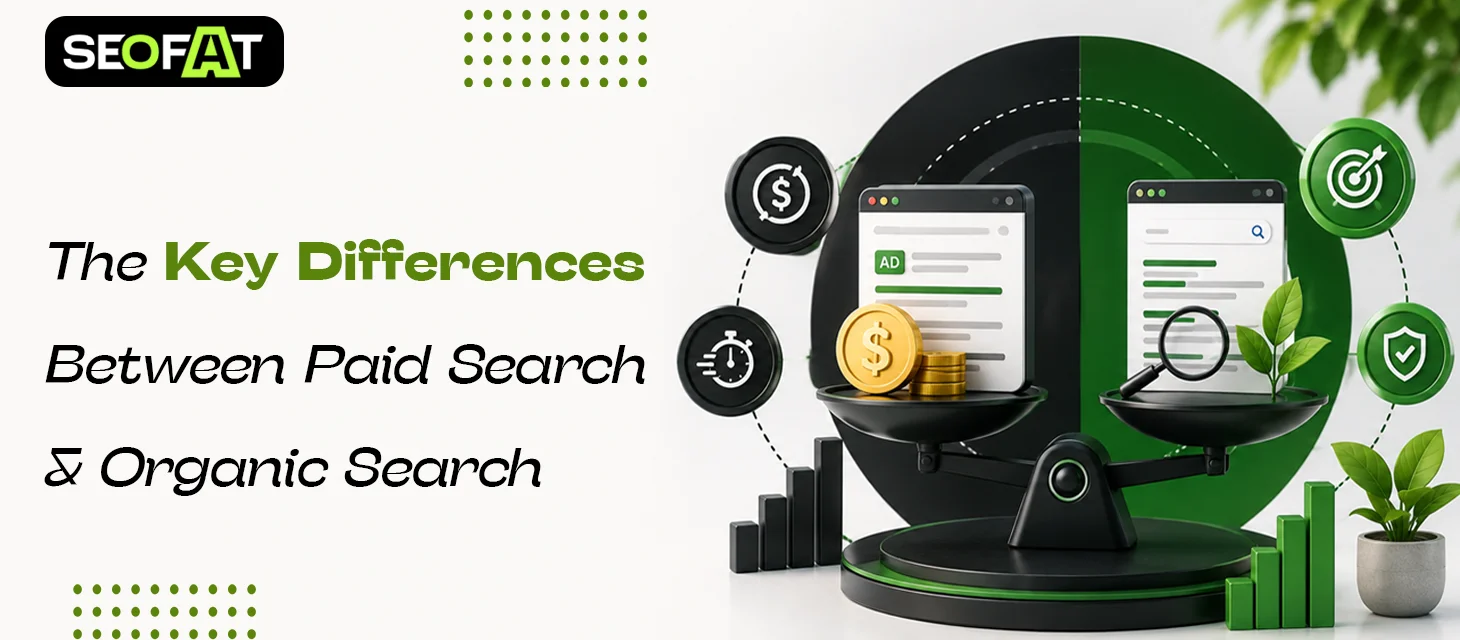
Paid search (PPC) gives a brand immediate traffic, helping with quick product launches or seasonal sales. Organic search (SEO) drives long-term growth and attracts high-quality traffic that improves business sales over time. Let’s understand the core difference between Paid vs Organic Search in detail.
Paid search requires a consistent advertising budget. Businesses typically pay when users click their ads. The pricing models can be different for every provider, and the cost of each click depends on factors such as competition, keyword intent, and ad quality.
SEO does not charge per click. It requires investment in content, technical improvements, and SEO tools for brand optimization in the long run.
| Cost Area | Paid Search (PPC) | Organic Search (SEO) |
|---|---|---|
| Payment to search engine | Usually tied to clicks or campaign bidding model | No payment for an organic click |
| Main cost | Ad spend + campaign management | Content + technical SEO + optimisation + expertise |
| Keyword competition | Higher competition can increase CPC pressure | Higher competition makes organic visibility harder to earn |
| Budget control | Daily and campaign budgets can be set | Spending depends on the SEO program and resources |
| Cost visibility | Campaign spend is directly measurable | Costs are distributed across SEO activities |
| Cost per click | Actual CPC can vary by auction | No direct CPC for organic listings |
| Primary financial metric | CPC, CPA, ROAS, conversion value | Organic conversions, qualified traffic, revenue, assisted conversions |
PPC is designed for quick demand and visibility. Once an eligible campaign enters the advertising auction, ads can compete for available placements. Each search triggers an auction, changing the ad visibility. SEO has a longer optimization cycle as it crawls, indexes, and then ranks pages. Google values E-E-A-T signals to organically place the best performers at the top.
| Performance Stage | Paid Search (PPC) | Organic Search (SEO) |
|---|---|---|
| Keyword targeting | Set through campaign targeting and keyword controls | Based on content relevance and search intent |
| Initial visibility | Can occur soon after campaign approval and eligibility | Depends on crawling, indexing, relevance, competition, and ranking |
| Traffic control | Budget and targeting provide direct control | Rankings determine visibility |
| Testing speed | Fast; ads and landing pages can be tested quickly | Slower; organic changes need time to evaluate |
| Campaign changes | Budget, bids, ads, targeting, and landing pages can be changed quickly | Content and technical changes require implementation and monitoring |
Google identifies paid listings with an “Ads” label. Organic results appear separately and are not combined with paid ads. Paid placement is finalized in the ad auction, while organic results are generated by Google rankings. If a brand has quality content and landing pages, it automatically gets priority in ranking for both paid ads and organic results.
| SERP Element | Paid Search (PPC) | Organic Search (SEO) |
|---|---|---|
| Result type | Advertisement | Search result |
| Placement | Can appear in designated ad locations, including above or below organic results | Appears within Google's organic search results |
| Position mechanism | Ad Rank and auction factors | Organic ranking systems |
| Bid involved | Yes | No |
| Search context | Location, device, time, query, and other signals can affect ad auction results | Search context and ranking systems determine organic results |
| Payment required for placement | Yes, through the advertising system | No advertising payment required |
Trust signals are one of the most important ranking factors for both strategies. A paid listing is clearly identified as an advertisement. Organic visibility is earned through Google's search systems, which evaluate multiple pages to show top results. Pages with the strongest trust signals optimize their brand, query, reputation, content quality, and user experience.
| Factor | Paid Search (PPC) | Organic Search (SEO) |
|---|---|---|
| User knows it is advertising | Yes | No advertising label |
| Visibility depends on ad budget | Generally yes | No direct payment per organic click |
| Brand exposure | Strong while campaigns are active | Can continue through organic rankings |
| Authority building | Limited direct authority benefit from buying ads | Can support topical authority through useful content and references |
| Content investment | Mainly focused on ad and landing-page performance | Often broader across the customer journey |
| Risk | Rising CPCs, competition and campaign inefficiency | Ranking changes, competition and outdated content |
The real advantage is that SEO can build search assets. A strong service page can attract relevant users without advertising charges for each organic visit.
PPC creates performance data. Ad engagement and conversion data reveal what customers respond to, supporting broader marketing decisions.
The best strategy for business growth depends on your business vision and budget. Use PPC (Pay-Per-Click) for instant traffic and fast leads, and SEO (Search Engine Optimization) to build long-term organic visibility. However, the best marketing efforts are seen when businesses combine both channels. To scale your online visibility, marketers don’t treat paid search vs organic search separately.
To understand the best choice for your business, find the strategy that supports your business requirements.
| Business Requirement | Better Fit | Why |
|---|---|---|
| Generate traffic for a new offer quickly | PPC | Paid campaigns can enter the ad auction as soon as they are eligible |
| Promote a limited-time sale | Budget and campaign dates provide direct control | |
| Capture high-intent demand immediately | Ads can target relevant commercial searches | |
| Build visibility for informational searches | SEO | Content can target topics and search intent over time |
| Develop topical authority | A site can build useful content around related subjects | |
| Reduce dependence on paid acquisition | Organic traffic does not require an ad payment for every click | |
| Understand conversion-focused messaging | PPC + SEO | PPC provides fast performance data SEO applies insights at scale |
| Maximize overall search presence | The channels address different stages and search opportunities. |
Paid vs Organic Search - Still debating which is right for your business?
If you want quick traffic with long-term growth opportunities, partner with SEOFAT. By improving organic visibility and long-term qualified traffic, we help businesses make smart marketing decisions by effectively combining SEO and PPC strategies.

SEO forecasting predicts future organic traffic, rankings, and revenue by analyzing historical data, search volumes,...
Read More
Pinterest is more than a social media platform. It functions primarily as a visual search...
Read More
To improve website performance in both traditional and AI search engines, brands often implement Open...
Read More
Keyword cannibalization becomes a core risk for brands that publish a high number of content...
Read More