



Meet
Get started with professional SEO services by requesting a strategy proposal today from the top-rated SEO company.

Be where your customers are and your competitors aren’t- AI search results.
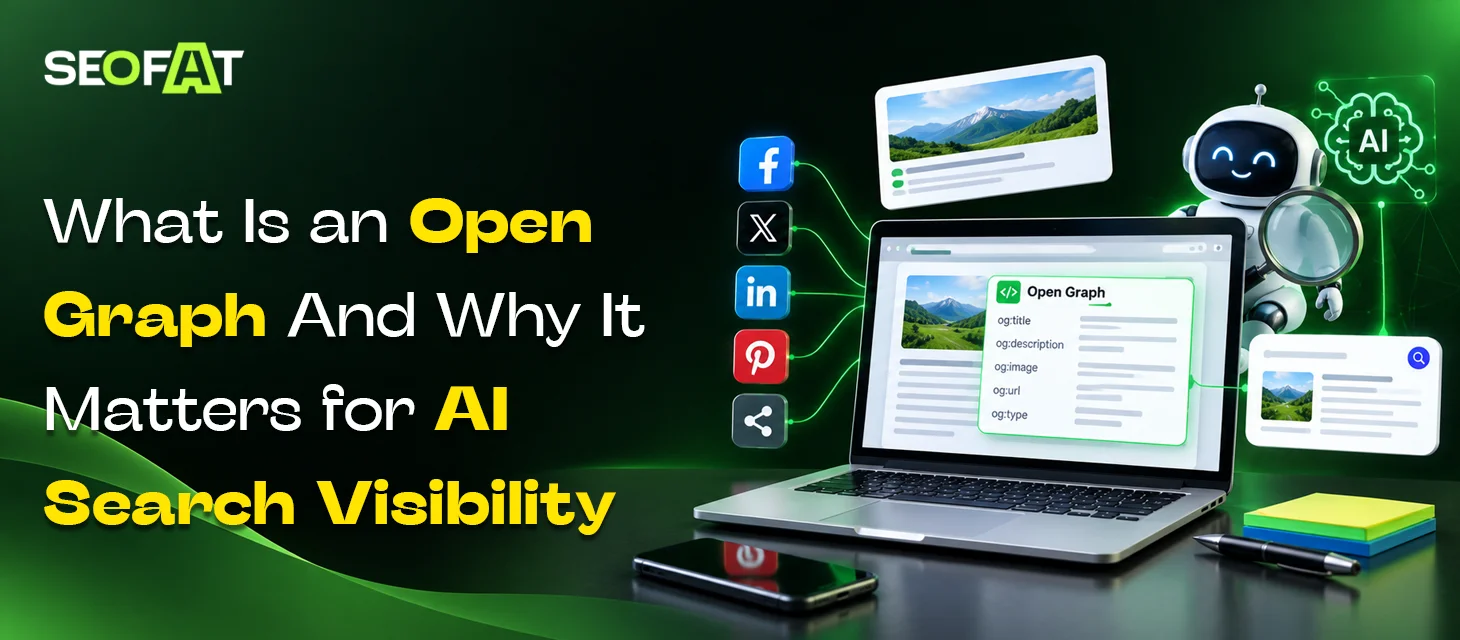
Get SEO ProposalTo improve website performance in both traditional and AI search engines, brands often implement Open Graph protocols. Open Graph is a metadata protocol that helps platforms understand your URL, webpages, and entity signals to discover your content easily and improve business performance.
Open Graph was originally developed to improve how webpages appear when shared on social platforms. However, clean and consistent metadata can also support wider content discovery across AI platforms. For improved performance, Open Graph should be treated as one part of a larger technical SEO and AI visibility strategy.
This blog explores how Open Graph improves AI search visibility through better content and metadata.
Open Graph is an internet protocol that uses HTML metadata to control how web pages appear as rich preview cards when shared on social media. Created by Facebook in 2010, it can be used to turn any webpage into a "rich object" inside a social graph. By using Open Graph meta tags in a website's code, brands gain direct control over how their links look. It helps to present links properly when shared across major social networks and messaging apps.
Instead of letting platforms auto-scrape a random image or clip your text, Open Graph enables you to explicitly state what the preview card should display, vastly improving brand consistency and click-through rates (CTR).
1. og:title
The title of your object or page as it should appear in the preview card (keep under 60 characters).
2. og:type
The general type of your content, such as "website" or "article".
3. og:image
The absolute URL of an image representing your page (ideally 1200x630 pixels).
4. og:url
The permanent canonical URL used as the unique ID for your page
These identify the title, object type, image, and URL of the page. You can also add properties such as og:description to provide more context. The main goal is to give platforms clear information about what your page represents.
AI search systems need to process large amounts of web content. They need to understand what a page is about, what information it contains, and whether it is relevant to a user's question. Open Graph metadata can provide another structured description of a webpage. However, you should not assume that every AI search engine uses Open Graph tags as a ranking signal. AI visibility depends on much more than metadata.
Important areas include:
This means Open Graph is best used as a supporting technical element. It helps keep your website's page information clear and consistent. Your actual content still needs to provide the information AI systems and users are looking for.
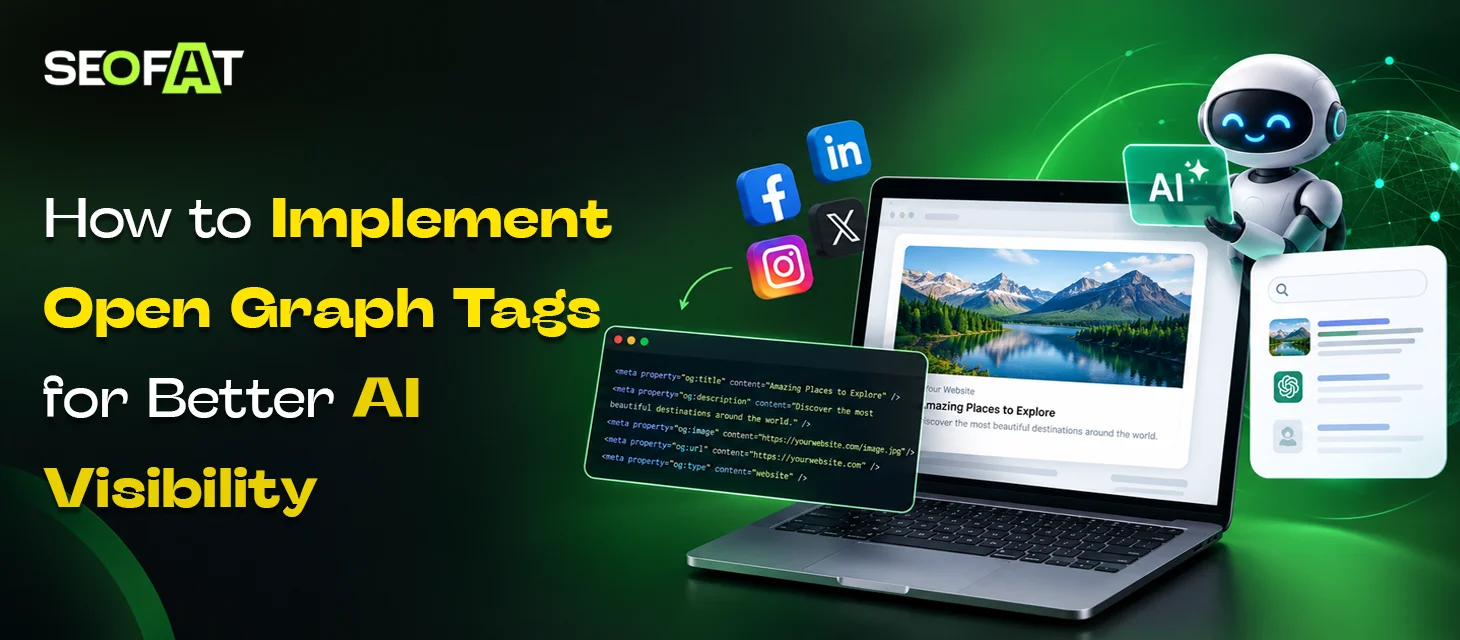
To implement Open Graph (OG) tags for better AI and search visibility, add core metadata tags inside the <head> section of your website's HTML. The key is to make sure each tag is accurate and matches the content of the page.
Start with the four main Open Graph tags:
<meta property="og: title" content=" What Is Open Graph and Why It Matters for AI Search Visibility">
<meta property="og:type" content="article">
<meta property="og:url" content="https://example.com/open-graph-ai-search">
<meta property="og:image" content="https://example.com/images/open-graph-ai-search.jpg">
These tags tell platforms the main title, type, URL, image, and description of your page.
Your og: title should clearly describe what the page is about. Avoid adding multiple keywords just to make the tag look optimized. Keep the title natural, clear, and relevant to the page.
Use og: description to give a short summary of the page. Make sure the description matches the information users will find on the page. Do not fill the description with keywords or make claims that your content does not support.
The og: type value tells platforms what type of content the page represents. For a general website page, you can use"website". For a blog post or article, use"article". Choose the type that best matches the actual page.
Your og:url should point to the preferred version of the page. Avoid using tracking parameters or duplicate URLs in your Open Graph URL. Keeping the canonical URL and og:url aligned creates a more consistent technical setup.
Your Open Graph image should represent the content of the page. Use a relevant image for each important page instead of using the same generic image across your entire website.
For article pages, you can add additional information such as the publication and modification dates. This can make your article metadata more complete.
Your Open Graph information should match the actual content of your page.
| Page Element | Example |
|---|---|
| Page Title | What Is Open Graph And Why It Matters for AI Search Visibility |
| og:title | What Is Open Graph And Why It Matters for AI Search Visibility |
Open Graph (OG) tags do not directly influence search engine rankings or AI search visibility, but they form a vital part of metadata hygiene that supports shared previews, multimodal AI retrieval, and click-through rates.
Here are the top tags to optimize:
The headline of your content; keep it aligned with your main on-page H1 and title
A short summary of the page. Keep it consistent with your visible text and meta.
The visual asset used when shared. Use intentional, high-contrast images with standard dimensions.
The canonical link of the page. Must match your standard canonical tag to prevent mixed authority signals.
The nature of the content, such as articles or websites.
Follow these practices to improve your visibility in AI search platforms.
Align All Elements:
Ensure your og: title, page headings, schema names, and standard title tags point to the exact same phrasing to remove guesswork for parsers.
Keep Canonicals Uniform:
Make sure the og:url matches your rel-canonical URL. This helps to avoid splitting signals between different versions of a page.
Control Visual Assets:
Define a clear og: image instead of letting platforms guess or display broken defaults, aiding visual trust and multimodal AI search previews.
Automate via Templates:
Build OG fields directly into your content management system templates so metadata never goes missing during scaling.
Prioritize Core SEO First:
Fix crawlability, indexability, structured data, and page architecture. It should be done before fine-tuning Open Graph data.
Open Graph, Schema markup, and meta descriptions are all hidden pieces of code located in the <head> section of your website. However, all of these serve completely different audiences and perform distinct jobs. Here is a brief to help you understand:
| Feature | Meta Descriptions | Open Graph (OG) | Schema Markup (Structured Data) |
|---|---|---|---|
| Primary Audience | Traditional Search Engines (Google) | Social Media & Chat Apps (Facebook) | Search Engines & AI LLMs (Google) |
| Layer of Operation | Search Layer: Controls text snippets. | Preview Layer: Controls visual preview cards. | Meaning Layer: Defines data entities and context. |
| Common Formats | Standard HTML tag | HTML tags | JSON-LD script blocks |
| Direct SEO Ranking Impact | No (but drives click-through rate) | No (drives social engagement and traffic) | No (but qualifies you for rich snippets and AI visibility) |
Open Graph tags are a simple but useful part of a strong SEO setup. They help define your page title, description, URL, type, and image. However, they are not a direct AI ranking factor. Better AI search visibility depends on helpful content and technical website performance.
Ready to improve your AI search visibility? Partner with SEOFAT and build a stronger SEO strategy today.


SEO forecasting predicts future organic traffic, rankings, and revenue by analyzing historical data, search volumes,...
Read More
Pinterest is more than a social media platform. It functions primarily as a visual search...
Read More
Keyword cannibalization becomes a core risk for brands that publish a high number of content...
Read More
Automated SEO reports help businesses manage performance data by automating SEO workflows, enabling quick identification...
Read More