



Meet
Get started with professional SEO services by requesting a strategy proposal today from the top-rated SEO company.

Be where your customers are and your competitors aren’t- AI search results.
Get SEO ProposalModern users prefer both AI platforms and traditional search engines for their daily research. For businesses that aim to improve online presence, AI search optimization and SEO are among the most effective and widely used strategies.
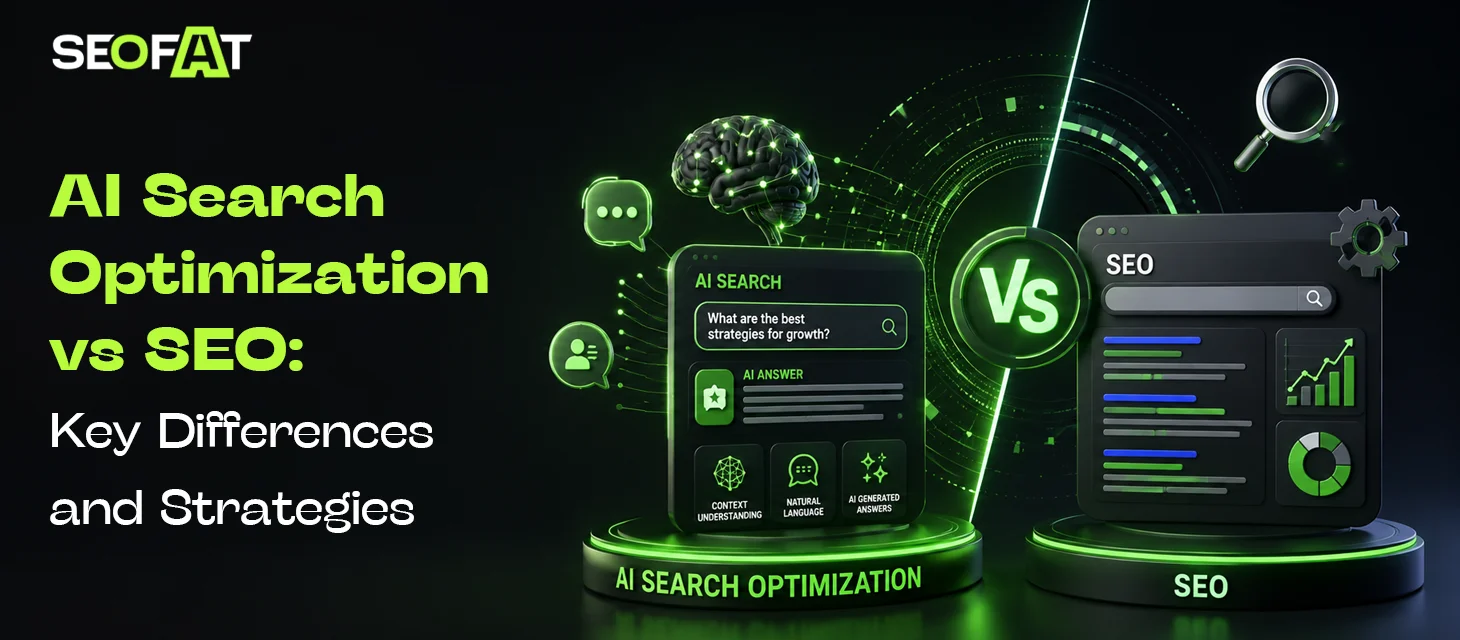
Traditional SEO helps search engines understand and rank web pages, while AI SEO and AEO focus on making content clear, credible, and easy for platforms like Google AI Overviews and Perplexity to understand, surface, and cite. Professional AI SEO agencies like SEOFAT help businesses optimize for both traditional search and AI platforms, aligning SEO and AEO with user intent, brand goals, and long-term visibility.
Follow along with the blog for a detailed analysis of AI Search Optimization vs SEO.
Traditional SEO helps search engines crawl, understand, index, and rank content for relevant queries. AI search optimization works on how AI systems retrieve information and construct answers from multiple sources.
SEO focuses on ranking individual webpages in a list of search engine results by targeting keywords and building backlinks. It typically targets measurable search outcomes such as:
A traditional SEO strategy targets keywords that are commonly used by the audience. For accurate optimization, the content is updated to match the search intent and compete for visibility in conventional search results.
AI search introduces a broader set of considerations. Visibility in AI search means being cited inside that generated response rather than earning a click from a ranked link. Instead of returning ranked pages for users, it synthesizes information from multiple sources and provides a direct response with supporting citations.
SEO helps brands rank as websites when users search their queries online. Avoiding this pattern, AI search results combine information from several sources to produce a contextual answer. A business may not rank in traditional search engine results, but with targeted content it can get cited in an AI-generated response. This does not make traditional rankings irrelevant. Traditional ranking earned using SEO offers businesses long-term search visibility that helps with consistent lead generation.
SEO always prioritizes keyword research to target the right user intent. However, for AI search optimization, businesses focus on solving user queries in simple and easy terms to become a helpful source. AEO (answer engine optimization) is a key strategy in AI Search optimization, helping businesses publish content that helps users with accurate answers with verified sources, rather than repeating the same keyword.
A useful content structure can move from broad to specific:
Core topic → related questions → practical explanation → examples → evidence → next step
A strong topical structure gives readers a complete resource while helping search systems understand the relationship between concepts. It helps brands establish their content authority and build relevance in the industry.
AI search optimization ensures that businesses focus on becoming a useful source, not simply producing pages targeting the same keyword.
Here is a simple table to understand the core differences.
| Area | Traditional SEO | AI Search Optimization |
|---|---|---|
| Main objective | Improve organic search visibility | Improve visibility and potential reference in AI answers |
| Core audience | Search engine users | Users asking AI-powered search questions |
| Primary focus | Rankings and organic traffic | Retrieval, relevance, citations, and answer usefulness |
| Keyword strategy | Target queries and topics | Cover questions, entities, concepts, and related intents |
| Content | Search-focused, helpful content | Clear, comprehensive, evidence-backed content |
| Technical foundation | Crawling, indexing, site architecture | Same technical foundation plus AI crawler accessibility |
| Authority | Links, reputation, expertise | Reputation, expertise, evidence, source quality |
| Measurement | Rankings, traffic, conversions | Citations, AI visibility, referrals, conversions, assisted impact |
| Content format | Pages, blogs, guides, landing pages | Clear sections, direct answers, comparisons, tables, structured information |
| Long-term goal | Sustainable organic visibility | Sustainable presence across search and AI discovery |
Answer Engine Optimization focuses on structuring and optimizing your content for AI engines like ChatGPT, Perplexity, and Google AI Overviews. AEO makes business websites easy to read, trust, and cite in user answers. Top AEO strategies include:
To ensure your content ranks effectively in AI searches, AEO includes the following strategies.
BLUF Approach:
Answer the user query first in any content. Ensure readers can find their answers faster without any confusion. Start with the key takeaway and then add supporting details.
Focused Sections:
Keep the content targeted on one clear topic. Use clear headings so readers can quickly understand what each section covers.
Direct Language:
Use simple words and active sentences. State facts clearly instead of using complicated wording or unnecessary introductions.
Clear Formats:
Use bullet points, tables, and numbered steps for processes. These formats make detailed information easier to scan and understand.
To support website performance, AI SEO strategies include:
Structured Data:
Add relevant schema markup to describe content on the page. Use appropriate types such as Article, Product, or Breadcrumb where applicable.
Crawler Access:
Check robots.txt, noindex directives, and sitemaps to ensure important content remains accessible. For ChatGPT Search, OpenAI recommends allowing AI bots to access content you want discovered and cited.
Entity Clarity:
Clearly define your services, products, and areas of expertise. Keep these details consistent across your website and important external profiles.
To build website authority using AI SEO or AEO, ensure you follow:
Topical Clusters:
Build connected content around your core expertise instead of publishing isolated articles. Link related pages to create clear relationships between topics.
Original Evidence:
Add case studies, research, expert opinions, first-hand observations, screenshots, and original data. This gives readers information they cannot get from generic content.
External Linking:
Earn relevant mentions from industry publications and other credible sources. Focus on relevant business mentions and avoid linking with unrelated websites.
Multimedia Presence:
Use useful videos, pictures, and other visual content to add context. Google recommends supporting AI-search content with high-quality multimedia when appropriate.
SEO helps brands build strong organic visibility that covers user intent. Over time, it helps build topical authority and improves business SERP performance.
SEO targets relevant keywords to match user intent. These direct search terms help capture direct user queries and offer target services and pages for help.
It includes optimizing titles, URLs, alt text, links, and more. It helps businesses publish high-quality content that builds topical authority.
It helps maintain a user-friendly website. It helps review site speed, Core Web Vitals, and linking issues to keep websites smooth and fast.
SEO focuses on creating original, targeted, and optimized content for search engines. SEO content answers users' queries and builds knowledge around important topics to establish topical depth.
SEO helps businesses earn relevant backlinks from credible websites. It helps to showcase genuine business expertise and industry authority while building a strong brand image.
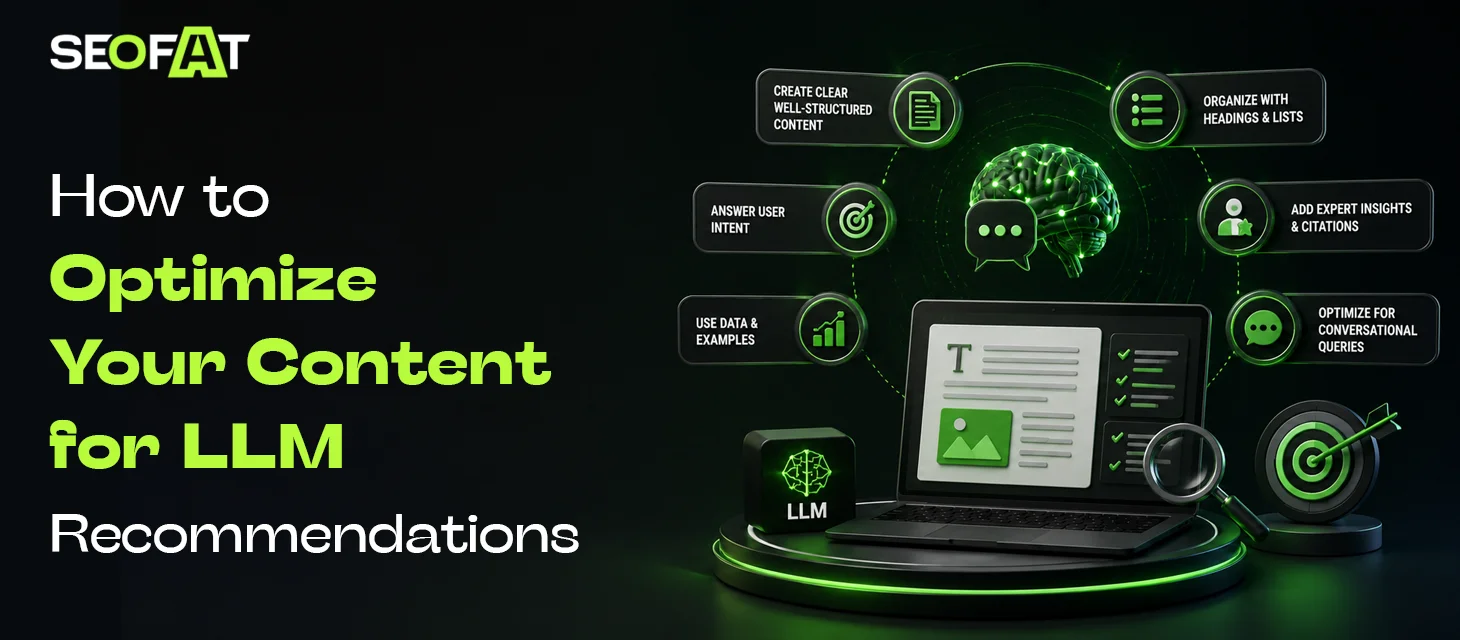
To optimize content for large language model (LLM) recommendations, focus on clear, modular structuring, direct answers using the "bottom line up front" approach, and strong entity associations.
Organize content with proper headings like H1, H2, or H3. Use short paragraphs, as they are easy to scan for readers.
Give a direct answer under each heading to avoid confusion. Ensure your content is detailed but answers user queries directly for faster discovery. This is referred to as the bottom-line-up-front approach.
Use summaries, bullet points, and comparison tables. These structures make content easier to read and improve its chances of being cited.
Use reliable data and expert insights in your content with clear sources. Perform original research and mention your references to improve your credibility.
Use relevant structured data, such as Article, FAQ, and How-to schema.
Earn quality backlinks from reliable platforms that are related to your industry. Ensure you share quality content to earn backlinks and improve your business authority.
Want your content to rank in AI search results?
Partner with SEOFAT for professional AI SEO services and get your business visible in AI results. Our AI SEO experts offer practical optimization strategies to improve content visibility, strengthen AI discoverability, and build a stronger presence across AI search engines.

SEO forecasting predicts future organic traffic, rankings, and revenue by analyzing historical data, search volumes,...
Read More
Pinterest is more than a social media platform. It functions primarily as a visual search...
Read More
To improve website performance in both traditional and AI search engines, brands often implement Open...
Read More
Keyword cannibalization becomes a core risk for brands that publish a high number of content...
Read More