



Meet
Get started with professional SEO services by requesting a strategy proposal today from the top-rated SEO company.

Be where your customers are and your competitors aren’t- AI search results.
Get SEO ProposalAI is now a regular part of content creation for businesses, helping teams produce content faster and more efficiently. Professional teams use artificial intelligence to research topics, build outlines, fill content gaps, and improve existing pages with efficient automation. However, whether AI content works for SEO remains a big question. Using AI content for SEO can speed up keyword targeting, but it only works when the content is helpful, accurate, intent-focused, and high-quality.
Using unoriginal texts with factual errors can cause low engagement. This is why, to use AI content for SEO, businesses must focus on strict human editing and refinement in line with Google's E-E-A-T guidelines. With professional content marketing service providers like SEOFAT, let’s understand the benefits, risks, & top AI SEO Tips for using AI content to improve your SEO performance.
AI-generated content is commonly used by brands to automate content production. The issue is not using AI to write content; it is using old, generic, or inaccurate content. So, no - using AI content is not bad for SEO. However, it must be accurate, up to date, and helpful to avoid low-value spam.
Google has stated that appropriate use of AI content generation with a focus on E-E-A-T can help businesses create valuable and high-performing content. The risk appears when marketers or businesses use AI for mass-producing low-value pages just to target keywords.
Content marketing services help businesses differentiate between these two core approaches. Let’s understand them in depth.
AI-assisted content is a process in which human writers use AI tools to get help with their content pieces. It can be used to handle research and outlines, while editing the document, fact-checking the data, and taking creative charge of the piece.
AI-assisted content might involve a writer using AI to:
AI-generated content is any text, image, video, or audio created by AI models. It may include producing content and publishing it with little or no meaningful human review.
This approach carries greater quality risks because it can lead to content repetition, no-intent targeting, and use of fluffy information.
AI content can support SEO when it is edited using proper research and fact-checking. It should answer the user's question clearly and match the right search intent to support SEO performance.
Use AI for Research and Content Planning: AI can help marketers find the latest topics and trending content to publish. It can help brands stay aware of user intent and target the right keywords.
Add Real Expertise to the Content: AI does not have first-hand experience with any business. To use AI-driven content marketing services, make sure to edit it and add your business products and performance to create optimized, accurate, personalized content.
Add:
These details are unique to your business, making your content more effective and high quality.
Fact-Check Before Publishing: AI hallucinations are common in generic searches and bulk content production. It is important to verify content and frequently include statistics such as pricing and business details. Every important claim should be checked against reliable sources before publication.
AI content can support an SEO strategy, but following E-E-A-T is one of the most effective AI SEO strategies. Google's E-E-A-T framework focuses on Experience, Expertise, Authoritativeness, and Trustworthiness to ensure every piece of content published online is useful for users.
Show that someone has actually dealt with the subject. For example, an SEO agency can include lessons from real campaigns, website audits, testing, or client work where appropriate.
Content should demonstrate genuine knowledge of the subject. Use qualified authors, subject matter experts, or expert reviewers when the topic requires specialist knowledge.
Build credibility through original research, useful resources, expert contributions, and recognition within your industry.
Keep information accurate and transparent. Cite important claims, update outdated information, provide clear business details, and make it easy for readers to understand who created or reviewed the content.
AI content becomes risky when brands prioritize volume more than content quality.
Copying an AI article directly onto your website can lead to generic data with no intent. Such articles are not useful for users and businesses. A human editor must check the structure, accuracy, and tone before publication.
AI makes content production easy. Creating unoptimized location pages or thin articles with little unique information can result in a poor website experience. Google specifically warns against scaled content abuse. It avoids producing large amounts of content primarily to manipulate search rankings rather than help users.
Using artificial intelligence for SEO helps to scale content production, speed up research, and target the right user intent and keywords. Core benefits include:
Using AI content for SEO can risk penalties for scaled content abuse. If content is mass-produced with factual inaccuracies and a lack of original insights, it risks being flagged as spam. While search engines accept AI work, unedited mass publishing often fails to provide unique value or meet quality guidelines.
Core SEO Risks
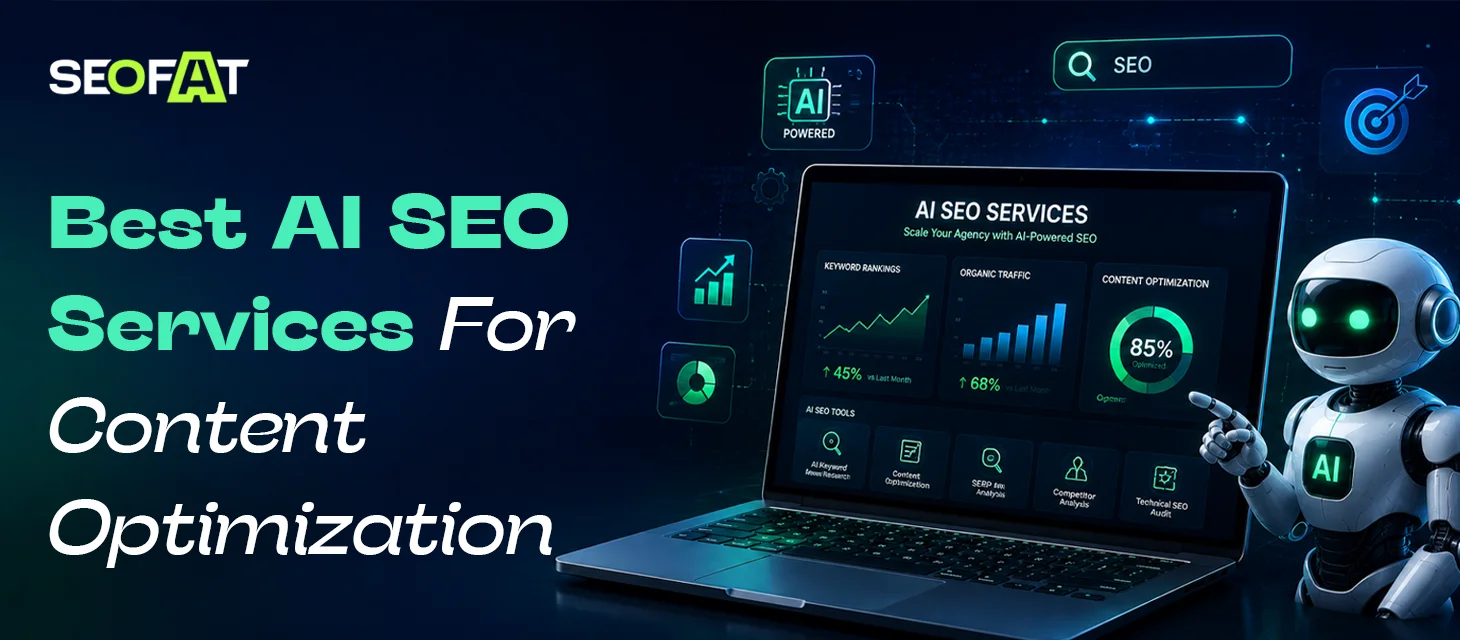
The top AI SEO agencies offer targeted AI SEO services for content optimization. Specialized agencies like SEOFAT offer complete AI SEO services. The best AI SEO tips for content optimization include:
Build content for ChatGPT, Gemini, Perplexity, and Google AI Overviews by targeting conversational queries. It helps brands work on citation opportunities and optimize with a conversational brand tone.
Use AI to create structured drafts that are valuable for readers. Content must strengthen semantic relevance and add entities to improve topical authority and better AI discovery.
AI can help with seo audit services, which help to identify gaps. It helps with targeted improvement in schema markup, organizing knowledge graph data, and finding internal linking opportunities.
It helps to track AI citations, share of voice, keyword rankings, and competitor visibility across traditional search and AI platforms. This helps businesses understand their performance and online visibility, which helps with better optimization.
Looking for a professional team to optimize your AI content?
SEOFAT offers businesses AI-driven SEO, content optimization, technical SEO, and semantic improvements to deliver visible SEO benefits. Our AI SEO approach helps turn AI text into useful and targeted content that supports stronger rankings, brand visibility, and organic growth for your business.

SEO forecasting predicts future organic traffic, rankings, and revenue by analyzing historical data, search volumes,...
Read More
Pinterest is more than a social media platform. It functions primarily as a visual search...
Read More
To improve website performance in both traditional and AI search engines, brands often implement Open...
Read More
Keyword cannibalization becomes a core risk for brands that publish a high number of content...
Read More