



Meet
Get started with professional SEO services by requesting a strategy proposal today from the top-rated SEO company.

Be where your customers are and your competitors aren’t- AI search results.
Get SEO ProposalBrand tracking across AI search engines has become an essential part of modern business optimization as more users turn to AI-powered search for information, recommendations, and purchasing decisions. A website may rank well in traditional search engines like Google, but its visibility on platforms like ChatGPT, Google AI Overviews, or Gemini is now equally essential to rank in zero-click answers and AI responses.
AI brand monitoring helps businesses track changes in AI platforms, query coverage, mention detection, citations, competitor comparisons, and data reporting. With consistent brand tracking, businesses can support AI search monitoring, brand visibility tracking, competitor research, content planning, citation analysis, and reputation management, thereby improving credibility and authority across AI platforms. Professional AI SEO agencies like SEOFAT can help businesses improve search visibility and support their brands in AI Search Engines.
Learn how to track brand mentions in AI search, including key metrics, useful platforms, and common mistakes to avoid for stronger AI search visibility.
AI brand mentions occur when generative tools like ChatGPT name your company, product, or service in responses to users. This means that when a user searches for a product or service in your business niche, AI mentions your brand as a credible provider. That mention in a user query is termed a brand mention.
The mention can appear in different forms. The platform may recommend your brand directly, list it among competitors, describe one of your services, or cite your website as a source. This makes monitoring more complex than traditional keyword tracking.
AI search visibility is important today, as users are highly active on AI search platforms. Brand mentions influence how users discover and evaluate businesses, improving your user conversions. When people ask AI systems for recommendations, they often receive a short list, and being included in that list boosts user trust and market authority, as AI search engines online rank highly trustworthy resources.
Monitoring also helps identify whether any AI system describes your product incorrectly, uses outdated information, or repeatedly mentions a wrong detail. Without tracking, these patterns can be difficult to spot, and they will continue to harm your business authority.
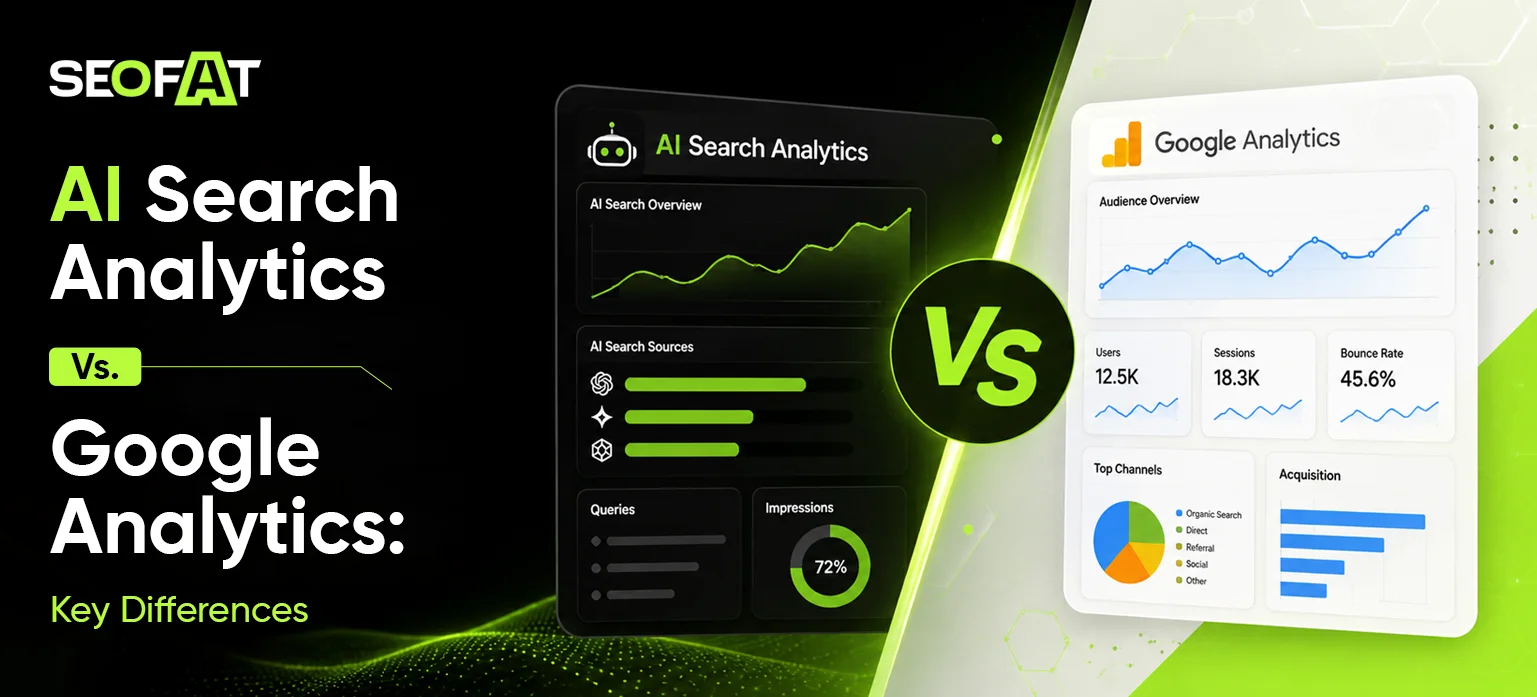
AI search analytics tracks brand visibility and citations within generative AI answers, while Google Analytics measures on-site user behavior, traffic, and conversions of any website visitor.
Google Analytics mainly shows what happens after users reach your website. It can provide information about metrics like traffic sources, landing pages, conversions, and engagement.
AI search monitoring focuses on what triggers the mentions. It understands how AI systems mention your brand, what content type is usually mentioned, and which sources are used by search engines for brand mentions.
| Measurement | Google Analytics | AI Search Monitoring |
|---|---|---|
| Main focus | Website activity | AI visibility |
| Measures brand mentions | No | Yes |
| Tracks website sessions | Yes | Usually no |
| Tracks AI citations | No | Yes |
| Shows landing pages | Yes | Sometimes through cited URLs |
| Shows conversions | Yes | Usually not directly |
| Tracks competitor mentions | Limited | Yes, depending on tool |
| Measures answer visibility | No | Yes |
| Useful for | Website performance | AI search presence |
Google Analytics remains a useful website analysis tool for business, but it does not replace AI visibility monitoring.
One of the most useful parts of AI search monitoring is understanding where the AI answer comes from. An AI system may mention your company but cite another website. For example, it might recommend your product based on a review published by a third-party website rather than your own product page.
Follow the steps if you prefer manual research.
Write down 10 to 20 questions your customers ask AI, such as "What is the best product for my needs?" or "Compare my brand to a rival".
Paste these questions into platforms like ChatGPT, Perplexity, Microsoft Copilot, and Google AI Overviews.
Record whether your brand appears, what sentiment the AI uses, and which source URLs the AI cites in a spreadsheet.
AI answers change often, so you must check regularly to see new trends.
Follow the steps if you prefer automated research.
Use specialized software like SE Ranking, Otterly, or Profound to run prompts automatically.
Let the tool test your brand questions daily or weekly without manual work.
Compare how often your rivals show up compared to your own brand
How a complete brand tracking process should look:
Once you understand how to track brand mentions in AI search, make sure you select the right channels for your research. The platforms worth tracking depend on your audience and market. However, you must work on:
ChatGPT can influence how users discover businesses, products, tools, and services through conversational search and research experiences. Brands should monitor prompts that ask for recommendations, comparisons, alternatives, and industry information.
Google is adding more AI-generated experiences to search. These results can summarize information from several sources and change how users interact with traditional organic listings. For businesses already investing in Google SEO, monitoring AI visibility provides another layer of search analysis.
Gemini can answer research and product-related questions in a conversational format. Brand monitoring can help businesses understand whether their content or brand is appearing when users ask questions related to their market.
Perplexity places a strong focus on answers supported by web sources and citations. This makes citation tracking particularly useful. You can examine whether your website or other trusted sources are being used when Perplexity answers questions related to your business.
Simply counting brand mentions and sources is not enough to build a strategy. A useful monitoring system should look at several parts of the answer.
Start by tracking how often your brand appears for a defined set of prompts. For example, an SEO software company could monitor 100 questions covering keyword research, rank tracking, technical SEO, AI search, and competitor comparisons. Over time, you can see whether your visibility is increasing or falling.
Share of voice compares your brand's AI visibility with competitors. If five companies appear frequently across the same set of prompts, you can measure how often each brand is included. This helps answer a more useful question and understand if you are being mentioned more than your competitors for the same audience.
Not every mention carries the same weight. A brand listed first in a recommendation may receive more attention than one mentioned near the end. Track where the brand appears when the platform provides a clear ordering.
Look at how the AI describes your brand. A mention can be positive, neutral, negative, or simply factual. It can help brands optimize their services to earn topical authority and expertise in the service.
For example, the system might describe a tool as:
These descriptions can reveal how AI systems understand your positioning.
Brands in competitive industries or markets that change quickly may want to monitor weekly. Smaller companies can start with monthly tracking and increase the frequency when important changes appear. More than the frequency of tracking, what's important is consistency. A repeated monitoring process creates a trend line, which offers businesses accurate results.
| Business Type | Suggested Monitoring | Main Focus |
|---|---|---|
| SaaS brand | Weekly | Product recommendations and comparisons |
| Ecommerce brand | Weekly | Product mentions and buying prompts |
| Local business | Monthly | Location and service searches |
| Agency | Weekly or biweekly | Service recommendations |
| Enterprise brand | Weekly | Brand, competitor, and reputation visibility |
| Small business | Monthly | Core commercial prompts |
AI search and traditional search overlap, but they are not identical. Google rankings still matter because users continue to search through traditional results. Organic traffic, technical SEO, backlinks, page experience, and conversions remain important business metrics.
Think of the two systems this way:
Using both gives marketers a broader view of search visibility.
Monitoring brand mentions across AI search engines gives businesses a clearer view of how brands appear beyond traditional Google rankings. Start with a fixed set of relevant prompts and track mentions, competitors, citations, and brand descriptions. Keep the process consistent to find accurate and effective insights into business performance.
If you need professional support to manage your brand tracking, partner with SEOFAT. We help businesses monitor AI search visibility and brand mentions as part of a complete SEO strategy. Our AI SEO services give brands a practical way to track mentions, understand competitor visibility, and use those insights to improve search presence.

SEO forecasting predicts future organic traffic, rankings, and revenue by analyzing historical data, search volumes,...
Read More
Pinterest is more than a social media platform. It functions primarily as a visual search...
Read More
To improve website performance in both traditional and AI search engines, brands often implement Open...
Read More
Keyword cannibalization becomes a core risk for brands that publish a high number of content...
Read More