



Meet
Get started with professional SEO services by requesting a strategy proposal today from the top-rated SEO company.

Be where your customers are and your competitors aren’t- AI search results.
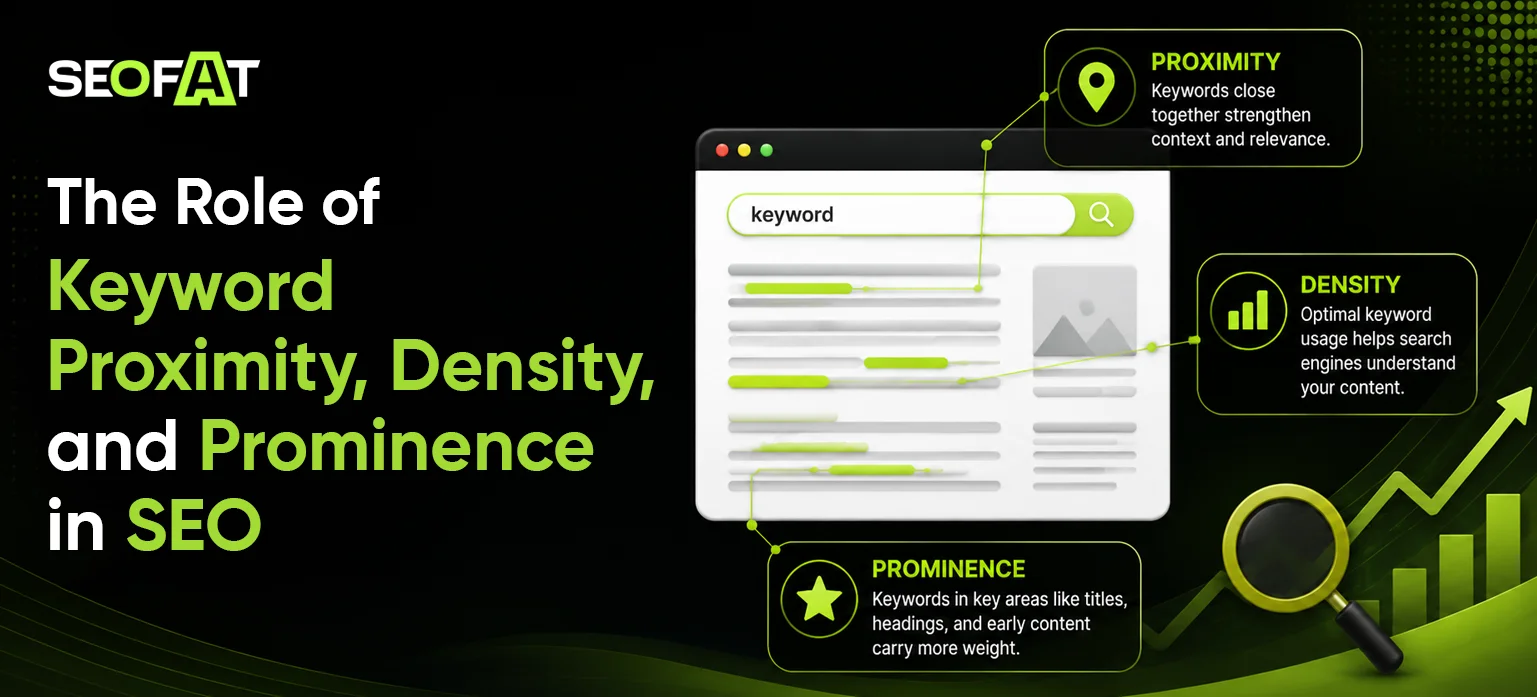
Get SEO ProposalKeyword proximity, density, and prominence are the foundations of on-page SEO — that’s how search engines such as Google determine what your page is about. Sure, algorithms like BERT and MUM have become far smarter in understanding meaning and context, but these basics still matter. They allow crawlers to read and index your content more efficiently. The balance of these three components ensures that your content is visible to search engines while still sounding natural to humans.
Keyword proximity measures the distance between individual words within a targeted multi-word phrase or long-tail keyword. Keeping target terms tightly bound signals immediate semantic context to search engines
High Proximity: Writing “We provide cheap SEO services in Chicago” places the terms next to each other. This architecture maximizes relevance for that exact phrase.
Low Proximity: Writing “Our SEO team is experienced in every facet of Internet marketing” pulls the terms apart. While search engines can still infer a relationship, the signal is weaker for the combined phrase.
SEO Impact: High proximity is equally essential for long-tail search queries, which are very competitive.
Keyword density refers to the number of times a keyword or keyphrase appears on a web page in relation to the total number of words in that web page. This is quite different from the raw frequency of a word, which is just how many times a word occurs without considering the length of the document.
Keyword Density: (Number of Keyword Repetitions / Total Word Count) X 100
The Golden Zone: Aim for a natural distribution between 1% and 2%. This translates to mentioning your keyword roughly 10 to 20 times per 1,000 words.
Keyword Stuffing: When the density exceeds the 3% threshold, it can be viewed as keyword stuffing. This suggests a bad user experience and spam to the search engines’ automated crawlers.
The New-Age Fix: Instead of using the same phrase over and over, introduce a few synonyms, contextual phrases, and entities that add more depth to your topic expertise.
Prominence is all about placement — where your target keywords are actually placed on the page. Search engines tend to scan top to bottom, so what shows up early carries more structural weight than what is further down.
Title Tags: Keep your main keyword ideally within the first 60 characters or so. The closer to the front, the better.
Headings: Your H1 should include the main keyword phrase, and try to work it into the first few words rather than tacking it on at the end. For your H2s and H3s, put in secondary keywords where they make sense — don't force them into every single one.
Introduction: Get your main keyword into that first paragraph, somewhere in the first 100–150 words. Readers (and crawlers) shouldn't have to hunt for what the page is about.
URLs and meta descriptions: Keep your URL short and clean, with the target keyword included. For the meta description, work the keyword in naturally, closer to the front half rather than at the end.
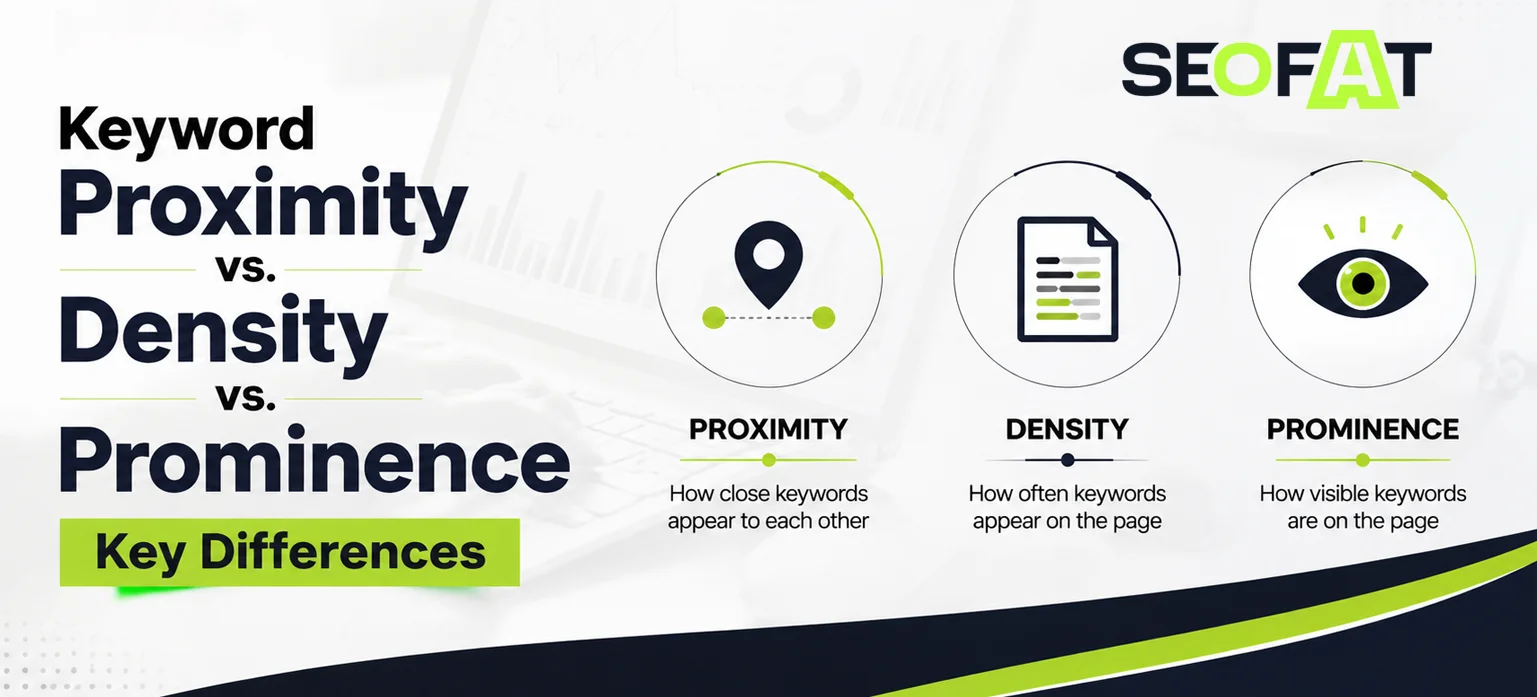
| Factor | Keyword Proximity | Keyword Density | Keyword Prominence |
|---|---|---|---|
| What it means | How close related keywords are to each other | How frequently a keyword appears on a page | Where a keyword appears on the page |
| Main focus | Relationship between terms | Frequency of use | Keyword placement |
| Example | “SEO services for dentists” keeps related terms connected | Using “dentist SEO” several times throughout an article | Using “dentist SEO” in the title or H1 |
| Why it matters | Helps make the connection between related terms clearer | Helps prevent a keyword from being barely mentioned or overused | Makes the page topic clear early on |
| Best practice | Keep related terms naturally connected | Use keywords naturally; don't chase a fixed percentage | Place important terms in relevant, high-visibility areas |
| Common mistake | Separating related terms unnecessarily | Keyword stuffing | Forcing the same keyword into every heading |
The mistake most people make is treating these three as a checklist they run through while writing. That's exactly backwards, and it's why so much "optimized" content reads like it was written by committee.
Before you type a single sentence, get clear on two things: what is this page actually about, and what does the person searching for it actually want? Not what you want to rank for — what they're hoping to find when they land here.
Once you know that, just write the thing. Explain it the way you'd explain it to a client.
Make the H1 say something specific instead of something vague and clever. Prominence isn't about cramming a phrase into the top of the page — it's about making sure the topic is obvious before someone has to dig for it.
Now go back through and look at how your ideas are grouped. Are related concepts sitting near each other, or does the page bounce between topics that are technically connected but read like separate thoughts put together?
You’re not forcing keywords together—you’re keeping related ideas connected so the content stays clear and focused.
There's no target number here. A 2,000-word guide and a 400-word FAQ answer aren't going to hit the same density, and that's fine. What matters is whether the term appears where a normal person would naturally read it.
At SEOFAT, we believe good SEO starts with understanding what people are actually searching for. Our team helps with keyword research to uncover relevant terms and search intent, then turns those insights into useful, natural content.
For more specific SEO needs, get in touch with our team to discuss the right approach for your business.


SEO forecasting predicts future organic traffic, rankings, and revenue by analyzing historical data, search volumes,...
Read More
Pinterest is more than a social media platform. It functions primarily as a visual search...
Read More
To improve website performance in both traditional and AI search engines, brands often implement Open...
Read More
Keyword cannibalization becomes a core risk for brands that publish a high number of content...
Read More