



Meet
Get started with professional SEO services by requesting a strategy proposal today from the top-rated SEO company.

Be where your customers are and your competitors aren’t- AI search results.
Get SEO ProposalAs Google shifts from traditional keyword targeting to semantic optimization, linking entities has become essential to build content around accurate meaning, context, and user intent. Entity linking helps search engines connect content to an entity (person, company, location, or product), which helps Google link it in its Knowledge Graph and trusted data sources, reducing content uncertainty and providing more relevant and trusted results.
Rather than building topical authority from keywords like traditional SEO, professional entity SEO providers like SEOFAT focus on building authority around entities and optimizing for AI searches and Zero-click results. Additionally, it helps improve market authority, website visibility, and create a better user experience.
In this guide, let’s learn how entity linking works and how it benefits your SEO performance.
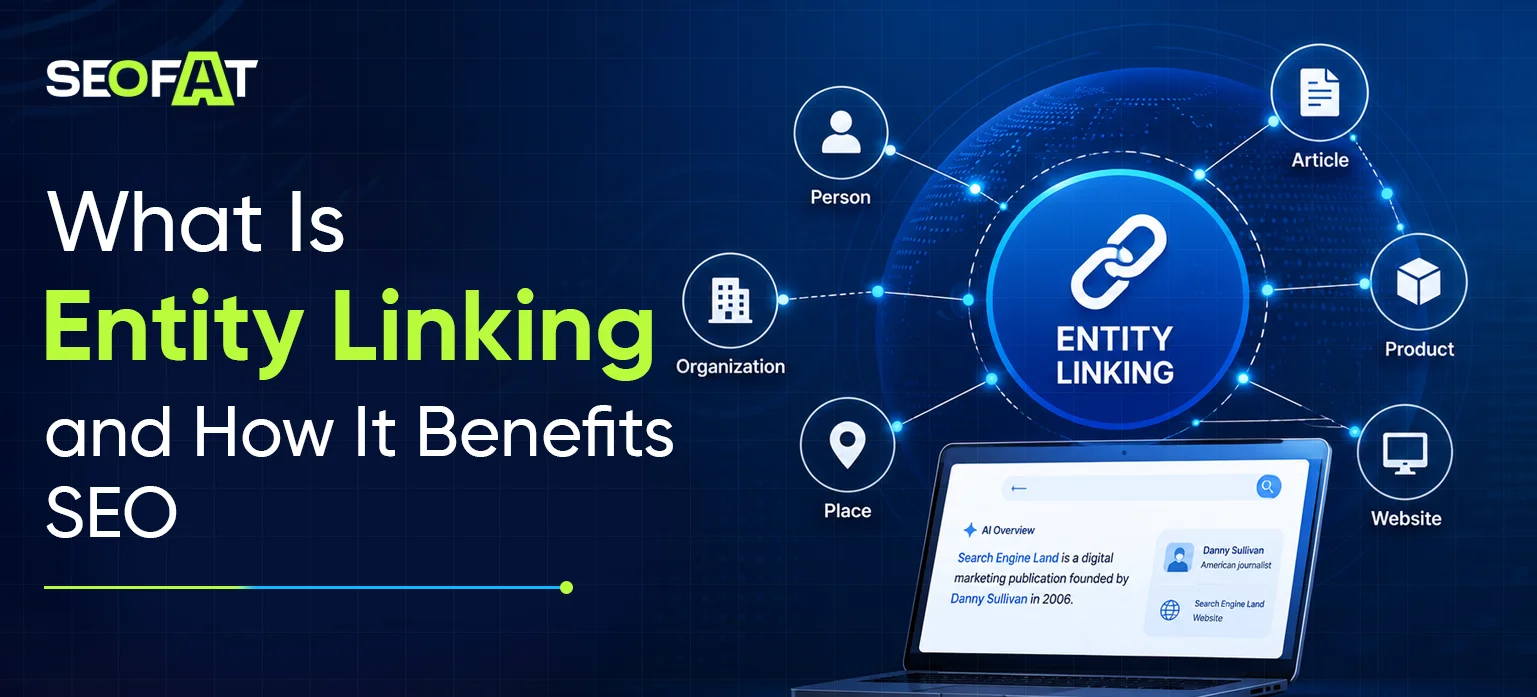
Entity linking is an advanced SEO process where businesses use specific words, phrases, or names to connect to a popular entity that is already recognized by search engines. Connecting with entities that are already in Google's Knowledge Graph or established as a trusted source helps brands share authority and link the intent.
Unlike traditional keyword optimization, entity linking helps search engines understand what your content is about using popular entities for ease and efficiency.
For example, if an article mentions "Tesla", entity linking helps Google assume the content links with Tesla, Inc., Nikola Tesla, or Elon Musk. This supports your content and builds semantic relationships, allowing search engines to deliver more accurate search results.
Entity linking improves how search engines interpret your content. Instead of relying only on keywords, Google evaluates relationships between entities to understand expertise, topical relevance, and user intent.
Benefits include:
Before Google ranks a page, it has to know what the content really means. Modern search engines look at entities to get clear context. Google spots these entities by getting information from trusted web sources, internal links, and external references. After understanding the links and relations, Google maps out relationships between the entities and helps search engines understand how they connect with the topic.
Signals Google Uses to Identify Entities Include:
For example, an article about digital marketing may naturally include entities such as:
The stronger these connections and entity signals are, the easier it becomes for Google to understand your content accurately.
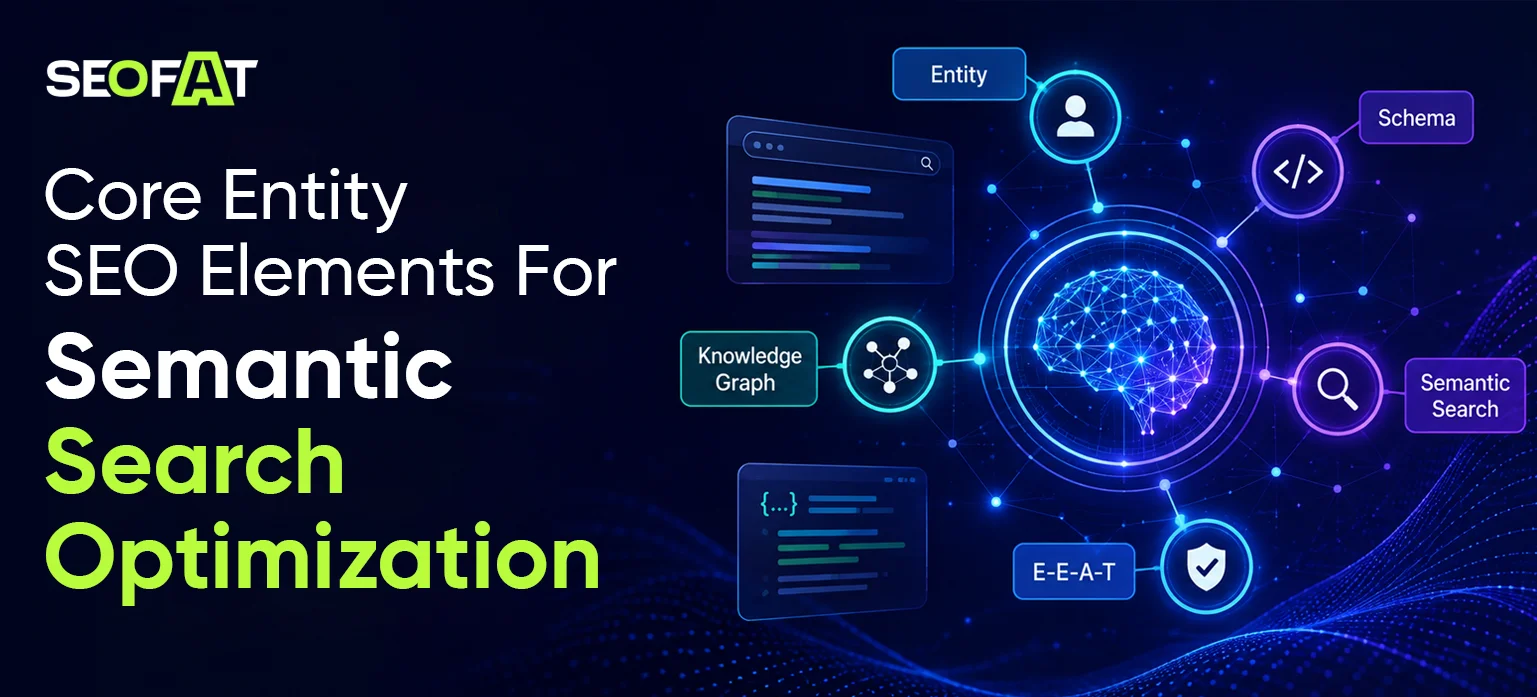
Entity SEO is not as simple as mentioning well-known brands or people. Search engines evaluate how entities connect with your content and how in-depth and clearly the entity has been linked in your content. The following Entity SEO elements can help you create stronger semantic relationships and improve topical authority.
Google's Knowledge Graph stores information about millions of recognized entities. It also describes their relationships to ensure content-easy entity linking. Optimizing your content around such recognized entities helps search engines understand your website more efficiently and connect it to related topics.
Best Practices
Structured data helps search engines get information about your content and interpret it more easily for better understanding. The FAQ schema markup helps your content identify entities in articles, products, people, FAQs, and reviews, strengthening authority signals and improving visibility in rich search results. Core schemas you must focus on:
Organization Schema: Identifies your business identity, brand name, and logo.
Person Schema: Shows author expertise and identities, supporting the E-E-A-T requirement for content authority.
SameAs Property: Connects your digital assets to established external database nodes, linking your entity to its corresponding Wikipedia or Wikidata URI.
About & Mentions Schema: Declares exactly what main entities the web page covers.
Common Schema Types
Google prefers websites that consistently publish high-quality content. If brands use entity linking accurately, their chances of getting featured in search results and top SERP increase. Instead of creating standalone articles, build interconnected content clusters that completely cover an entity and build better topical authority.
For example, an SEO website may publish guides about:
Together, these optimized pages demonstrate expertise and strengthen topical authority.
Internal links help search engines easily discover content and page relationships. Additionally, internal linking helps brands distribute authority across your website and guide users towards targeted pages. Use the best free internal linking checker tool that helps to show better results
Every important page should connect with targeted entities using natural and ethical linking.
Best Practices
Google uses Natural Language Processing to understand sentence structure, context, and entity relationships. Writing naturally is important to avoid keyword repetition and promote content more efficiently. For proper NLP, focus on explaining topics in simple words and in complete depth.
Good NLP practices include:
Search engines judge entities based on the surrounding text. Just mentioning a keyword is no longer enough to link to the entity. Your content must clearly explain its exact role, the links it provides, and its value to the topic.
For instance, if you are working on a guide for Entity SEO. Optimizing content for terms such as Knowledge Graph, Schema Markup, and Topical Authority helps Google understand what your blog covers and helps your content rank higher for many different related search terms.
SEO agencies and professionals must focus on entity linking to improve their page performance and content authority. Rather than targeting only simple keywords, ensure your content connects entities naturally to align with Google-recognized NLP and semantic analysis.
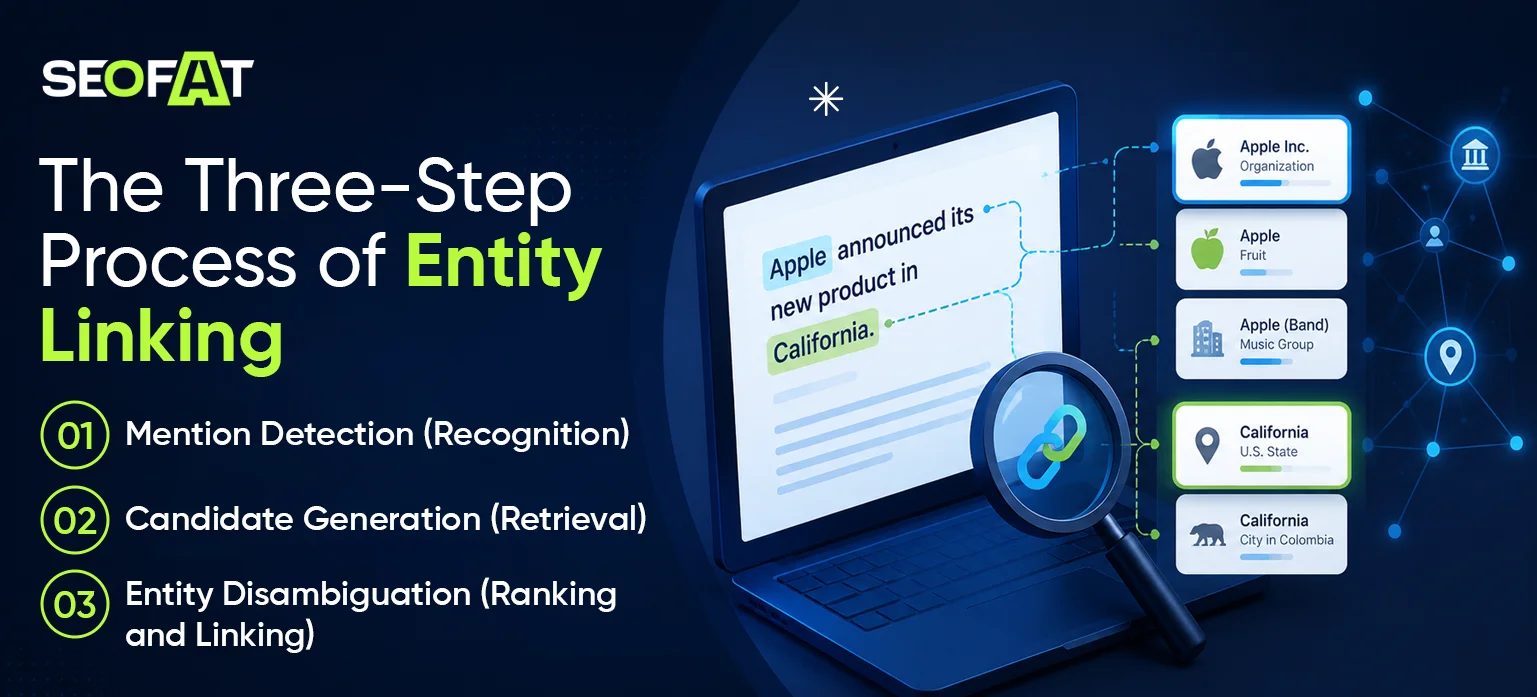
Understanding these three steps can help you with accurate entity linking, making it easier for search engines to understand and rank your content.
Mention detection is the first stage of entity linking. During this step, search engines scan your content to identify words or phrases that represent any real-world entity.
Google uses Natural Language Processing (NLP) to detect entities and recognize meaningful terms that can improve page authority and rankings.
How Mention Detection Works
Google identifies possible entities by analyzing:
Example
In the sentence: "Tesla launched new battery technology."
Google identifies Tesla as a brand, a potential entity that connects the content to the automotive or clean energy industries.
Once an entity mentioned has been detected, Google searches its knowledge sources. This is done to find every possible entity that matches that mention. This stage is known as candidate generation.
Many words can have multiple meanings. Search engines retrieve all possible candidates before deciding which one best fits the content.
For example, the word "Tesla" may refer to:
Google generates these possible entities before moving to the next step.
Search engines retrieve candidates using:
Example
If an article discusses electric cars, Google is more likely to associate Tesla, Inc. with the most relevant candidate.
Entity disambiguation is the final stage of entity linking. Here, Google compares all possible candidates and selects the best match.
For accuracy, search engines evaluate the surrounding content, related entities, related page topic, internal links, and overall semantic relevance. Once the correct entity is identified, Google connects it to its Knowledge Graph to better understand the page.
Signals Google Uses for Entity Disambiguation
Google determines the correct entity by analyzing:
Example
"Apple introduced its latest iPhone during its annual product launch."
Although Apple can refer to a fruit or the technology company, Google recognizes related entities such as iPhone and product launch, making it clear that the page refers to Apple Inc.
Internal entity linking and external entity linking are two semantic SEO methods used to connect content concepts to a knowledge graph. Internal entity linking maps concepts to your own website pages, while external entity linking maps concepts to trusted public databases.
| Internal Entity Linking | External Entity Linking |
|---|---|
| Connects related entities within your own website. | Connects content to recognized entities or trusted external sources. |
| Strengthens topical authority across your website. | Improves credibility by referencing authoritative entities. |
| Uses internal links between relevant pages and topic clusters. | Uses citations or links to trusted organizations, brands, research, or knowledge sources. |
| Helps search engines understand relationships between your pages. | Helps search engines verify entity context and semantic relevance. |
| Improves website crawlability and user navigation. | Builds trust and supports factual accuracy. |
| Example: Linking an "Entity SEO" guide to pages about Schema Markup, Semantic SEO, and Topical Authority. | Example: Referencing Google's Knowledge Graph, Schema.org, or W3C when discussing entity SEO concepts. |
Entity linking helps search engines find the actual meaning in your content and pages. When you connect key terms to known entities, Google reads your page with better trust and authority. The search engine maps out how topics relate and answers user queries while improving visibility in search results. This process improves a brand’s semantic relevance. It also boosts your odds of ranking for related terms, AI Overviews, and zero-click answers. Additionally, it builds deep topical authority. It proves that your content covers the whole subject rather than just targeting a high-volume keyword. When you mix entity linking with schema, internal links, and strong content, you get faster indexing and better online visibility.
Entity linking benefits SEO as follows:
Want top Entity SEO Services to strengthen your website's topical authority?
Partner with SEOFAT and benefit from advanced Entity SEO services that improve semantic search visibility, strengthen topical authority, and optimize structured data. Our team of SEO experts helps global businesses rank higher across Google Search, AI search engines, and answer engines using custom entity optimization services.


SEO forecasting predicts future organic traffic, rankings, and revenue by analyzing historical data, search volumes,...
Read More
Pinterest is more than a social media platform. It functions primarily as a visual search...
Read More
To improve website performance in both traditional and AI search engines, brands often implement Open...
Read More
Keyword cannibalization becomes a core risk for brands that publish a high number of content...
Read More